
Fixed-Rate vs. Adjustable-Rate Mortgages: How Each Works Over Time
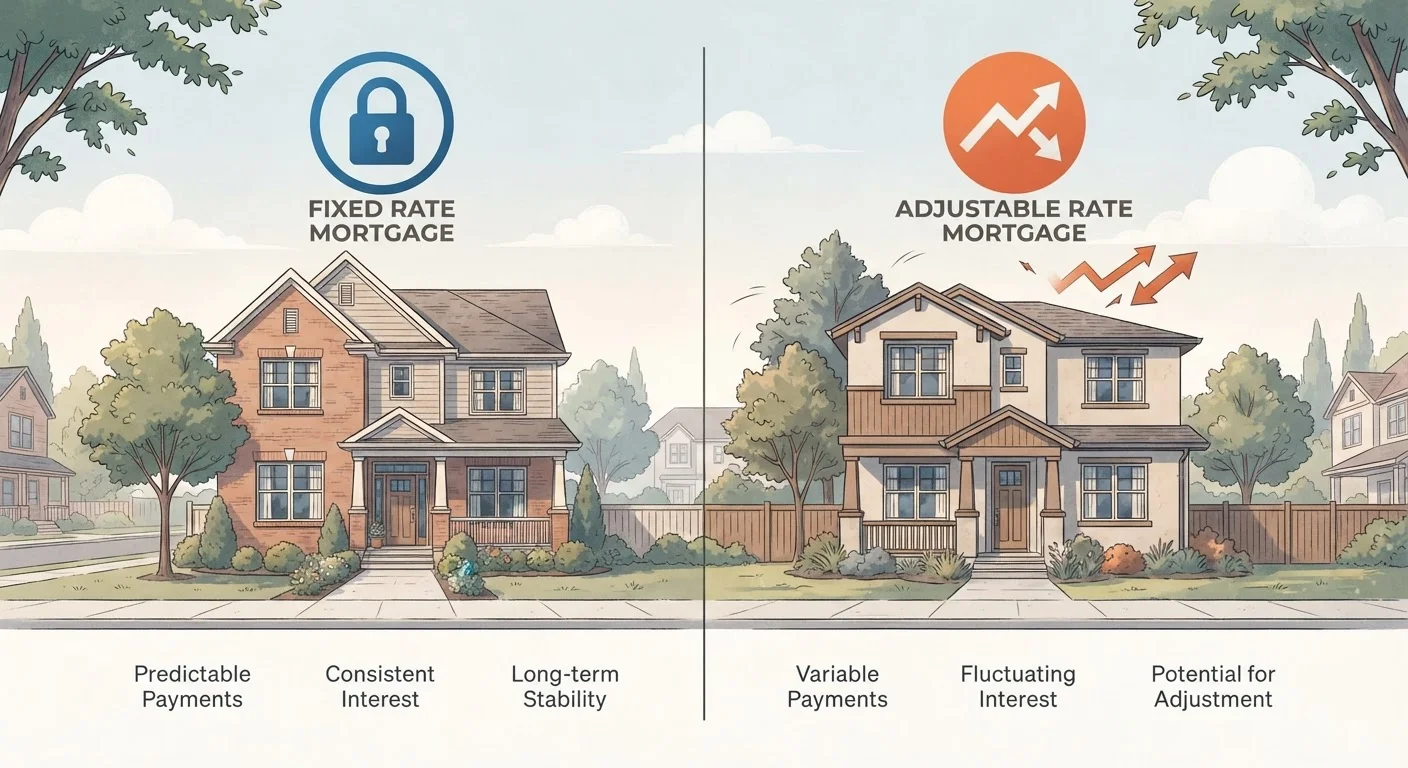
Photo credit: QuickInsights.net
In this article
Interest rate structure shapes your monthly payment for years. Here's what distinguishes ARMs from fixed loans and when each tends to suit buyers.
Key Takeaways
- Fixed-rate mortgages keep the interest rate constant for the entire loan term, making monthly principal-and-interest payments predictable.
- ARMs offer a lower initial rate for a set introductory period, after which the rate adjusts periodically based on a market index.
- The right choice depends on how long you plan to stay, your tolerance for payment variability, and where rates currently stand.
- Rate caps on ARMs limit how much the rate can rise per adjustment and over the life of the loan, but they do not eliminate risk.
- Total interest paid over time is not guaranteed on an ARM - it rises with the index if rates climb.
How Each Rate Structure Actually Works
A fixed-rate mortgage carries a single interest rate that does not change from the day the loan closes to the day it is paid off. Whether you have a 15-year or 30-year term, your principal-and-interest payment remains exactly the same throughout. See our breakdown of every mortgage payment component to understand what else appears on your monthly bill.
An adjustable-rate mortgage (ARM) works in two distinct phases. During the introductory period - commonly 5, 7, or 10 years - the rate is fixed, often at a level below prevailing fixed-rate offers. Once that period ends, the rate adjusts at defined intervals (typically annually) based on a benchmark index, such as the Secured Overnight Financing Rate (SOFR), plus a lender margin. The result can push your payment up or, in a falling-rate environment, down.
ARMs are typically named using a notation like 5/1 or 7/6. The first number represents the fixed introductory period in years; the second represents how often (in months or years) the rate adjusts afterward. A 5/1 ARM fixes the rate for five years, then adjusts once per year.
| Criterion | Fixed-Rate Mortgage | Adjustable-Rate Mortgage (ARM) |
|---|---|---|
| Interest rate over time | Constant for full loan term | Fixed initially, then adjusts periodically |
| Initial rate level | Typically higher than ARM intro rate | Usually lower than fixed for intro period |
| Monthly payment stability | Principal + interest never changes | Can rise or fall after intro period ends |
| Rate adjustment frequency | None | Annually (or per loan terms) after intro |
| Rate caps | Not applicable | Initial, periodic, and lifetime caps apply |
| Best ownership horizon | Long-term (10+ years) | Shorter-term (under 7-10 years) |
| Refinancing pressure | Low - rate is already locked | Higher - borrowers often plan to refinance before adjustments |
| Predictability of total interest | Fully calculable at closing | Variable - depends on future index movement |
Rate Caps: The ARM's Built-In Guardrails
Lenders are required to disclose ARM cap structures, which limit how dramatically your rate can move. Three types of caps typically apply:
- Initial adjustment cap: Limits how much the rate can rise at the first adjustment after the introductory period - commonly 2 percentage points.
- Periodic adjustment cap: Limits movement at each subsequent adjustment - also often 2 percentage points.
- Lifetime cap: Limits the total rate increase over the life of the loan - commonly 5 percentage points above the initial rate.
These caps matter, but they do not eliminate payment risk. A borrower who starts at a 6% introductory rate could legally reach 11% over the loan's life under a standard 2/2/5 cap structure. Understanding your specific caps before signing is essential. For a closer look at assumptions buyers often make about rate risk, see common financing assumptions that can cost homebuyers thousands.
ARM Index Changes: What Borrowers Should Know
Many ARMs originated before 2023 were tied to the London Interbank Offered Rate (LIBOR), which has since been discontinued. Those loans have generally transitioned to SOFR (Secured Overnight Financing Rate) as the benchmark. If you are reviewing an older ARM or assuming someone else's loan, confirm which index governs your adjustments and how the margin is applied. Lenders are required to notify borrowers of index changes, but understanding the new benchmark helps you anticipate future rate movements more accurately.
Cost Comparison Over Time
The fixed-rate loan's higher initial rate costs more in early monthly payments, but every dollar is predictable. On a $350,000 loan at a 7% fixed rate over 30 years, the monthly principal-and-interest payment is approximately $2,329. That figure does not change if rates rise to 9% nationally five years later.
An ARM at a 5.75% introductory rate on the same loan amount produces a lower starting payment - roughly $2,043 per month - but that advantage exists only during the fixed window. If the index rises sharply before or during adjustments, the payment can surpass what a fixed loan would have charged from the start. Conversely, if rates fall, the ARM borrower could benefit automatically without refinancing.
The break-even point depends on how long you hold the loan and how rates move - two variables no one can predict with certainty. Borrowers who plan a longer stay should also compare overall loan costs. Our analysis of 15- vs. 30-year mortgage trade-offs addresses how loan term interacts with total interest paid.
~30%
ARM share of mortgage applications during rate spikes
According to Mortgage Bankers Association data, ARM applications as a share of total mortgage activity have historically climbed when fixed rates rise sharply, reflecting borrower sensitivity to payment size.
5 pts
Maximum lifetime rate increase under common ARM caps
A standard 2/2/5 ARM cap structure limits total rate increases to 5 percentage points above the initial rate over the life of the loan.
7 years
Median tenure in a home before selling (approximate)
National Association of Realtors data has historically shown the median homeowner tenure at roughly 7-10 years, a figure relevant when assessing ARM introductory period alignment.
Choosing Based on Your Situation
Neither loan type is objectively superior - each suits a different buyer profile. Consider these factors as you evaluate:
- Ownership timeline: If you are confident you will move or refinance before the ARM's introductory period expires, you may not face any adjustments at all. If your plans are uncertain, a fixed rate removes that variable entirely.
- Current rate environment: When fixed rates are relatively low by historical standards, locking in tends to favor long-term holders. When fixed rates are elevated, the ARM's introductory discount carries greater appeal - though future adjustment risk remains real.
- Income stability: ARMs introduce payment uncertainty. Borrowers with variable income or tight monthly margins may find that unpredictability harder to absorb than those with significant financial cushion.
- Loan type compatibility: ARMs are available as conventional loans, and some government-backed products offer them as well. See how conventional, FHA, VA, and USDA loans compare to understand how rate type interacts with loan program eligibility.
For a deeper dive into what actually changes - and what stays constant - between these two mortgage types, see our companion piece on what changes and what doesn't with fixed vs. adjustable rates.
This article is for general informational purposes only and does not constitute personalized financial, mortgage, or legal advice. Mortgage terms, rates, and availability vary by lender and borrower circumstance. Consult a licensed mortgage professional before making loan decisions.

Author
Real Estate Editorial Team
Real Estate Editorial Team is the collective byline for our editorial team and contributor network. Articles published under this byline or an editorial pen name are researched, written, and reviewed according to our editorial standards for clarity, consistency, and independence before publication.
View all articles →