
Fixed-Rate vs. Adjustable-Rate Mortgages: What Changes and What Doesn't
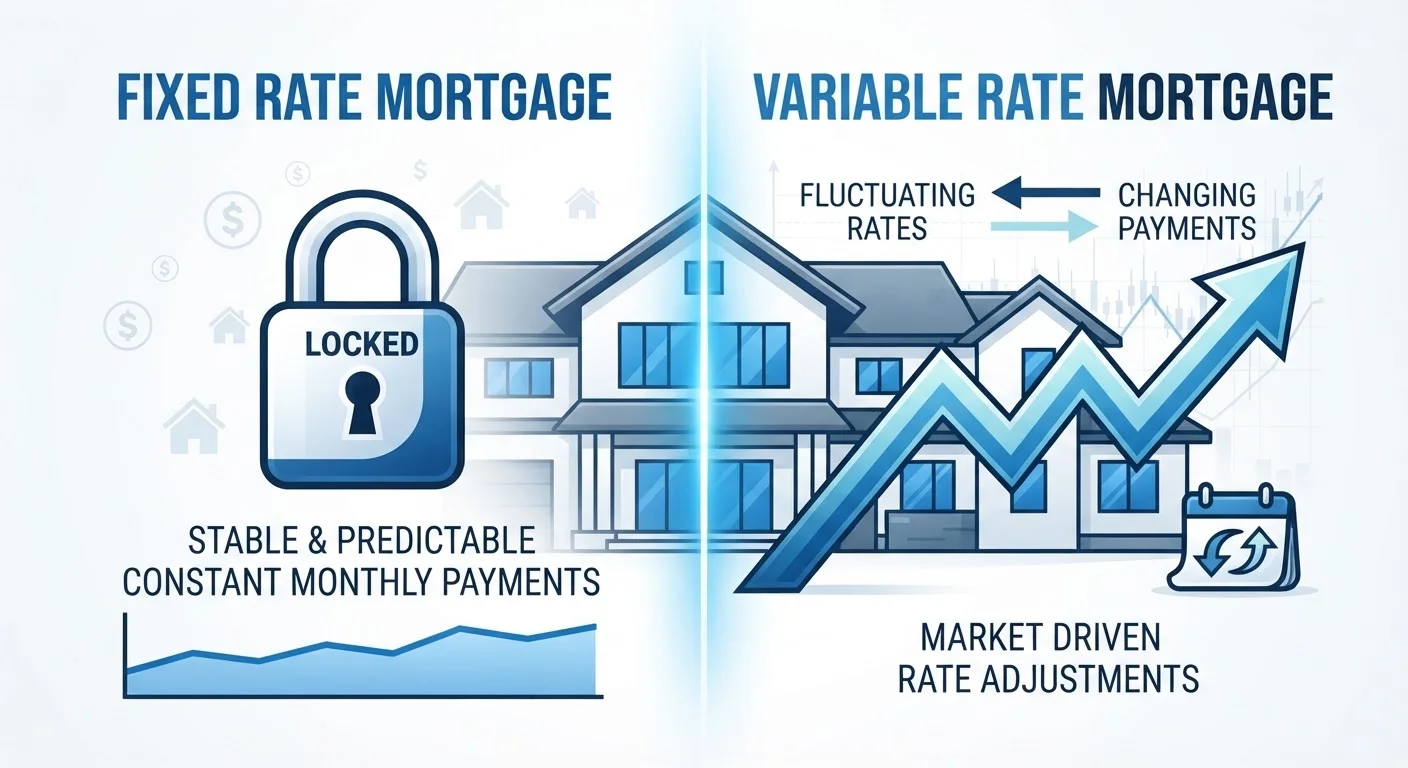
Photo credit: QuickInsights.net
In this article
Understand how fixed and adjustable mortgage rates work, when each makes sense, and what borrowers should weigh before choosing.
Key Takeaways
- Fixed-rate mortgages lock in your interest rate for the entire loan term, making monthly principal and interest payments unchanging.
- ARMs offer a fixed introductory rate for a set period, then adjust periodically based on a benchmark index plus a lender margin.
- Caps on ARM rate changes limit how much your rate can rise per adjustment and over the loan's lifetime.
- Fixed rates typically start higher than ARM introductory rates, but ARMs carry more long-term payment uncertainty.
- Your expected time in the home is one of the most important factors when choosing between these two structures.
- Both loan types can be refinanced later if market conditions or your financial situation change.
How Each Rate Structure Actually Works
A fixed-rate mortgage does exactly what its name suggests: the interest rate is set at closing and never changes. Whether you borrow for 15 or 30 years, your principal and interest payment stays identical from month one to the final payment. Property taxes and homeowners insurance (often bundled into escrow) can still fluctuate, but the core loan payment is immovable.
An adjustable-rate mortgage (ARM) starts with a fixed introductory rate - commonly for 3, 5, 7, or 10 years - and then adjusts periodically. A 5/1 ARM, for example, holds its rate steady for five years, then recalculates annually based on a benchmark index (such as the Secured Overnight Financing Rate, or SOFR) plus a fixed lender margin. The resulting rate can go up or down depending on where that index sits at each adjustment date.
ARM agreements include rate caps that limit exposure. A common cap structure is 2/2/5: the rate cannot rise more than 2 percentage points at the first adjustment, more than 2 points at any subsequent adjustment, or more than 5 points above the initial rate over the loan's lifetime. These caps matter - they define your worst-case payment scenario.
For a broader look at how loan type intersects with rate structure, see our comparison of conventional, FHA, VA, and USDA loans.
| Criterion | Fixed-Rate Mortgage | Adjustable-Rate Mortgage (ARM) |
|---|---|---|
| Interest rate over time | Locked in for full loan term | Fixed initially, then adjusts periodically |
| Starting interest rate | Typically higher than ARM intro rate | Typically lower during introductory period |
| Monthly payment stability | Principal & interest never change | Can rise or fall after fixed period ends |
| Rate adjustment caps | Not applicable | Per-adjustment and lifetime caps apply |
| Predictability | High - fully known at closing | Moderate - future payments uncertain |
| Best ownership horizon | Long-term (10+ years) | Short-to-medium term (3-7 years) |
| Risk exposure | Low - insulated from rate increases | Higher - exposed to market rate rises |
The Real Trade-Off: Certainty vs. Initial Cost
Fixed-rate mortgages generally carry a higher starting interest rate than the introductory rate on a comparable ARM. Lenders price in the risk of being locked into a rate that may fall below market for decades. Borrowers, in exchange, receive complete payment certainty.
ARMs typically open with lower rates precisely because the lender retains flexibility to reprice the loan later. That introductory discount can translate to meaningful savings during the fixed period - but only if the borrower exits the loan (through sale or refinance) before significant adjustments occur, or if rates decline rather than rise.
5/1
Most common ARM introductory structure
The 5/1 ARM - fixed for 5 years, then adjusting annually - has historically been among the most widely originated adjustable products in the U.S. market.
30 years
Standard fixed-rate loan term
The 30-year fixed-rate mortgage remains the dominant loan product in the United States, favored for its payment consistency over a long horizon.
2/2/5
Typical ARM rate cap structure
A 2/2/5 cap structure limits the first adjustment to 2 points, each subsequent adjustment to 2 points, and total lifetime movement to 5 points above the starting rate.
The calculus shifts based on how long you plan to hold the mortgage. A buyer who stays 30 years and takes an ARM faces considerable uncertainty after the introductory window closes. A buyer who sells within five years may never experience an adjustment at all. This is why expected ownership duration is the single most practical filter when choosing between structures.
It's also worth considering that ARMs can be refinanced into fixed-rate loans - a strategy worth understanding in detail through our guide to refinancing a home loan. Refinancing carries its own costs, however, and future rate availability is never guaranteed.
Buyers should also be cautious of mental shortcuts - for instance, assuming an ARM's low starting rate will persist, or that a fixed rate is always the "safe" option regardless of timeline. Our piece on financing assumptions that can cost homebuyers thousands addresses several of these directly.
What Stays the Same Regardless of Rate Type
Whichever structure you choose, several elements of your mortgage remain consistent. The loan term (15 or 30 years, most commonly) governs your overall repayment schedule. Amortization - the process by which early payments are weighted toward interest and later payments toward principal - applies equally to both. Your obligation to maintain homeowners insurance and pay property taxes doesn't change with rate type.
Qualification criteria are also largely parallel. Lenders evaluate your credit score, debt-to-income ratio, down payment, and employment history for both fixed and adjustable products. One nuance: some lenders qualify ARM applicants against a higher "stress-tested" rate (often the fully-indexed rate, not the teaser rate) to ensure the borrower could afford higher payments if adjustments materialize.
Both products also sit within the same broader mortgage ecosystem. For context on related costs that apply to both, see our overview of private mortgage insurance - a potential cost for borrowers with less than 20% down, regardless of rate structure.
Finally, both loan types can be accompanied by discount points - upfront fees paid to reduce your starting rate. Learn how mortgage points work and whether buying down your rate makes sense given your timeline.
This article is for general informational and educational purposes only. It does not constitute personalized financial, mortgage, or legal advice. Consult a licensed mortgage professional or financial adviser before making decisions about your specific loan situation.

Author
Real Estate Editorial Team
Real Estate Editorial Team is the collective byline for our editorial team and contributor network. Articles published under this byline or an editorial pen name are researched, written, and reviewed according to our editorial standards for clarity, consistency, and independence before publication.
View all articles →