
Conventional, FHA, VA, and USDA Loans: Which Fits Your Situation?
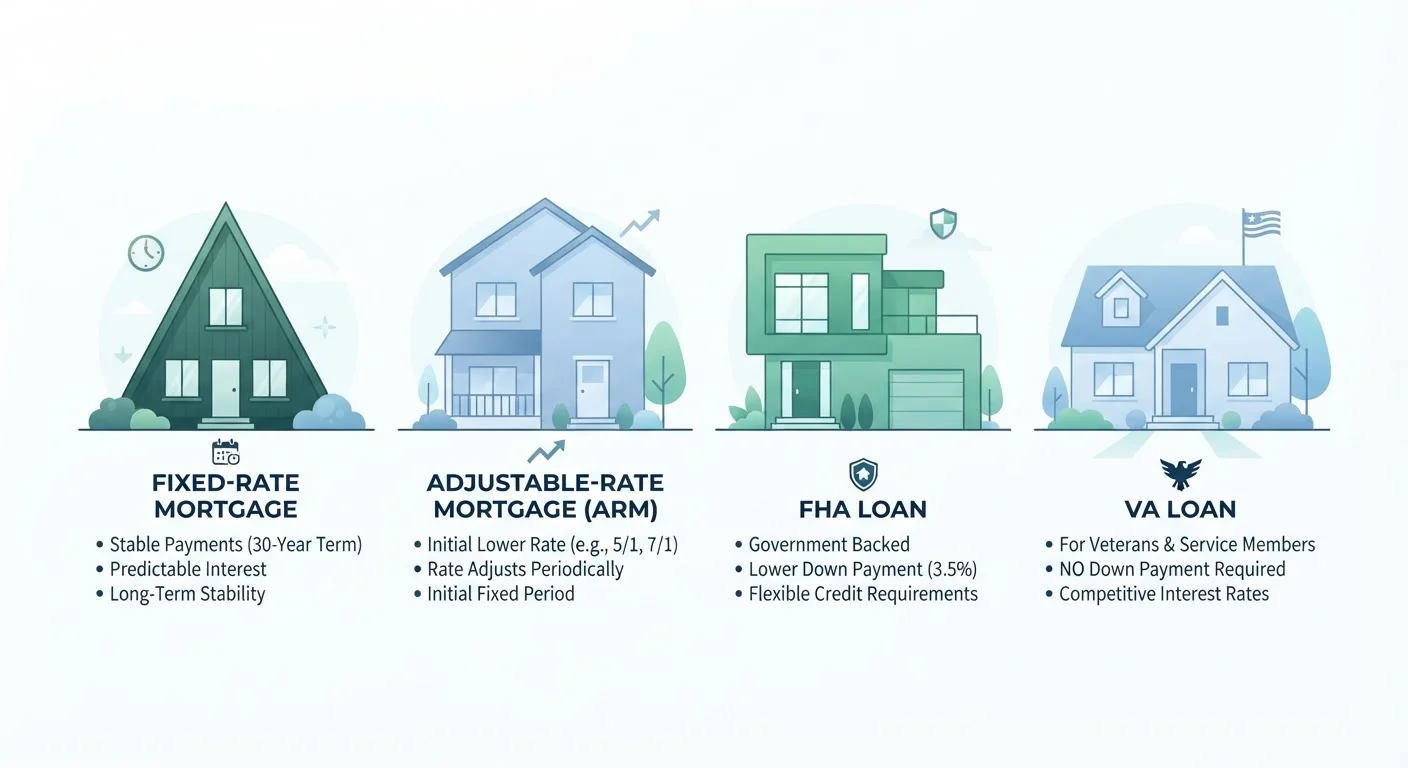
Photo credit: QuickInsights.net
In this article
A clear side-by-side look at the four most common U.S. mortgage loan types, including eligibility rules, down payment requirements, and trade-offs.
Key Takeaways
- Conventional loans suit borrowers with stronger credit and larger down payments but carry no government guarantee.
- FHA loans allow lower credit scores and down payments as low as 3.5%, but require mortgage insurance premiums.
- VA loans are available only to eligible veterans and service members and typically require no down payment.
- USDA loans serve buyers in eligible rural and suburban areas and also offer zero-down-payment financing.
- Each loan type has distinct eligibility rules, cost structures, and property requirements that affect your total borrowing cost.
Conventional Loans: The Standard Benchmark
A conventional loan is any mortgage not insured or guaranteed by the federal government. Lenders offer these loans and typically sell them to investors via the secondary market - meaning they must meet guidelines set by Fannie Mae or Freddie Mac (the two government-sponsored enterprises that purchase most conventional loans).
To qualify, most lenders require a credit score of at least 620, though stronger scores unlock lower interest rates. Down payments can be as low as 3% for certain first-time buyer programs, but borrowers who put down less than 20% must pay private mortgage insurance (PMI) - an added monthly cost that can be removed once sufficient equity is reached. Unlike government-backed mortgage insurance, PMI removal is achievable without refinancing.
Conventional loans are subject to conforming loan limits, which the Federal Housing Finance Agency adjusts annually. Loans above those limits are called jumbo loans and carry separate requirements. For borrowers with solid credit and savings, conventional financing often delivers the lowest total long-term cost. Before assuming which loan fits you, it helps to review foundational terms - our mortgage glossary covers essentials like LTV, PMI, and origination fees in plain language.
FHA Loans: Accessibility for a Wider Range of Buyers
FHA loans are insured by the Federal Housing Administration and designed to expand homeownership access. The key advantages are lower minimum credit requirements and a smaller mandatory down payment: borrowers with scores of 580 or above can put down as little as 3.5%, while those with scores between 500 and 579 may still qualify with a 10% down payment - though individual lenders often set higher internal thresholds.
The trade-off is mortgage insurance. FHA borrowers pay an upfront mortgage insurance premium (MIP) at closing (currently 1.75% of the loan amount, though this figure can change - verify current rates with a lender) plus an annual MIP collected monthly. For most FHA loans originated after 2013, this insurance stays for the life of the loan unless you put down at least 10%, in which case it falls off after 11 years. This ongoing cost is an important factor when comparing FHA against conventional alternatives.
FHA loans also have stricter property condition standards. An FHA appraiser checks for health and safety issues that a conventional appraisal might overlook, which can complicate offers on fixer-upper properties. Buyers should factor in the condition of their target home when evaluating whether FHA financing is feasible.
| Conventional | FHA | VA | USDA | |
|---|---|---|---|---|
| Government Backing | None | Federal Housing Administration | Dept. of Veterans Affairs | Dept. of Agriculture |
| Minimum Down Payment | 3%-5% (varies) | 3.5% (580+ credit) | 0% | 0% |
| Minimum Credit Score (general guideline) | 620 | 500-580 (with conditions) | No set minimum (lender discretion) | 640 (typical lender minimum) |
| Mortgage Insurance | PMI if <20% down; can be removed | Upfront + annual MIP; often for loan life | Funding fee (one-time); no PMI | Guarantee fee (upfront + annual) |
| Eligibility Restriction | None (meets lender standards) | None (meets FHA guidelines) | Military service requirement | Property location + income limits |
| Loan Limits | Conforming limits apply | FHA county limits apply | No set cap (entitlement-based) | Moderate income cap applies |
| Property Condition Standards | Moderate | Strict (appraiser-checked) | Strict (MPRs required) | Moderate to strict |
VA Loans: A Benefit Earned Through Military Service
VA loans are guaranteed by the U.S. Department of Veterans Affairs and are exclusively available to eligible veterans, active-duty service members, National Guard and Reserve members meeting length-of-service requirements, and qualifying surviving spouses. If you meet those criteria, VA loans offer terms that are difficult to match through any other program.
There is no minimum down payment required, no ongoing monthly mortgage insurance, and no set minimum credit score at the program level (though most lenders apply their own floors, commonly around 620). Instead of mortgage insurance, VA borrowers pay a one-time VA funding fee, which varies based on down payment amount, loan type, and whether it's the borrower's first use of the benefit. Certain veterans with service-connected disabilities may be exempt from this fee entirely.
VA loans require properties to meet Minimum Property Requirements (MPRs) - structural and safety standards similar to FHA criteria. Understanding how your rate structure interacts with loan type is also important; see our guide on fixed-rate vs. adjustable-rate mortgages to understand how rate choice compounds over time.
Get Pre-Qualified for Multiple Loan Types
Before assuming one loan type is out of reach, ask a HUD-approved housing counselor or mortgage professional to evaluate your eligibility across all four loan programs. Many buyers who initially think they only qualify for FHA discover they also meet conventional loan standards - or vice versa. Comparing actual loan estimates side by side, including total interest and insurance costs over time, gives you the clearest picture of true affordability.
USDA Loans: Rural and Suburban Homebuying With Zero Down
USDA loans - guaranteed by the U.S. Department of Agriculture - target homebuyers in eligible rural and certain suburban areas and carry income limits based on household size and location. Eligible borrowers can finance 100% of the purchase price with no down payment required, making this one of the few zero-down options available outside of VA financing.
Like other government-backed loans, USDA loans carry insurance fees: a guarantee fee charged upfront plus an annual fee rolled into monthly payments. Most lenders look for a credit score around 640, though the USDA itself does not set a universal minimum. Income eligibility is calculated against area median income figures, so moderate-income households in qualifying geographies are the primary audience.
The geographic restriction is the defining constraint. Not every property in a rural zip code qualifies, and some properties in small towns on the edges of metropolitan areas do qualify - the USDA maintains an online eligibility map that borrowers should check directly. If you're weighing USDA financing alongside other borrowing options after you become a homeowner, our overview of home improvement financing options can help you plan for future renovation costs as well.
~70%
Share of mortgages that are conventional loans
Conventional loans consistently represent the largest share of purchase mortgage originations in the U.S., according to data tracked by the Urban Institute's Housing Finance Policy Center.
0%
Down payment required for VA and USDA loans
Both VA and USDA loans allow qualified borrowers to finance 100% of the home's purchase price, making them among the few zero-down mortgage options available to civilians and veterans alike.
500
Lowest credit score accepted for FHA with 10% down
FHA guidelines technically allow scores as low as 500 with a 10% down payment, though most individual lenders set stricter requirements known as 'lender overlays.'
How to Choose Between the Four
Your optimal loan type is determined by intersecting eligibility, cost, and your financial profile. Work through these filters in order:
- Military service: If you or a qualifying family member served, check VA eligibility first - the combination of no down payment and no monthly mortgage insurance is difficult to beat.
- Location and income: If the property is in a USDA-eligible area and your household income falls within limits, USDA can offer comparable zero-down terms for civilian buyers.
- Credit score and savings: Scores of 620 or above with a meaningful down payment typically favor conventional loans due to removable PMI and flexible terms. Scores below 620, or limited savings, often point toward FHA.
- Property condition: If you're pursuing a fixer-upper, conventional financing may be simpler because its appraisal standards are less stringent than FHA or VA requirements.
Also consider total cost over time - not just the monthly payment. Mortgage insurance that stays for the loan's life (as with many FHA loans) can significantly increase total interest paid compared to conventional PMI that drops off. Avoid common assumptions about affordability; our article on financing assumptions that cost homebuyers thousands identifies the mental shortcuts that lead buyers to underestimate true borrowing costs.
Watch Out for Lender Overlays
Government-backed loan programs publish minimum guidelines, but individual lenders are free to set stricter requirements - called 'overlays' - on top of those baselines. A lender might require a 640 credit score for FHA even though FHA guidelines allow 580. If you're declined by one lender, shopping with another can sometimes yield a different result. Always verify whether a denial reflects program rules or that specific lender's overlay.
This article is for general informational purposes only and does not constitute personalized financial, mortgage, or legal advice. Loan guidelines, fees, and limits change over time and vary by lender. Consult a licensed mortgage professional or HUD-approved housing counselor for guidance tailored to your circumstances.

Author
Real Estate Editorial Team
Real Estate Editorial Team is the collective byline for our editorial team and contributor network. Articles published under this byline or an editorial pen name are researched, written, and reviewed according to our editorial standards for clarity, consistency, and independence before publication.
View all articles →