
State Minimum vs. Full Coverage: Weighing the Trade-Offs
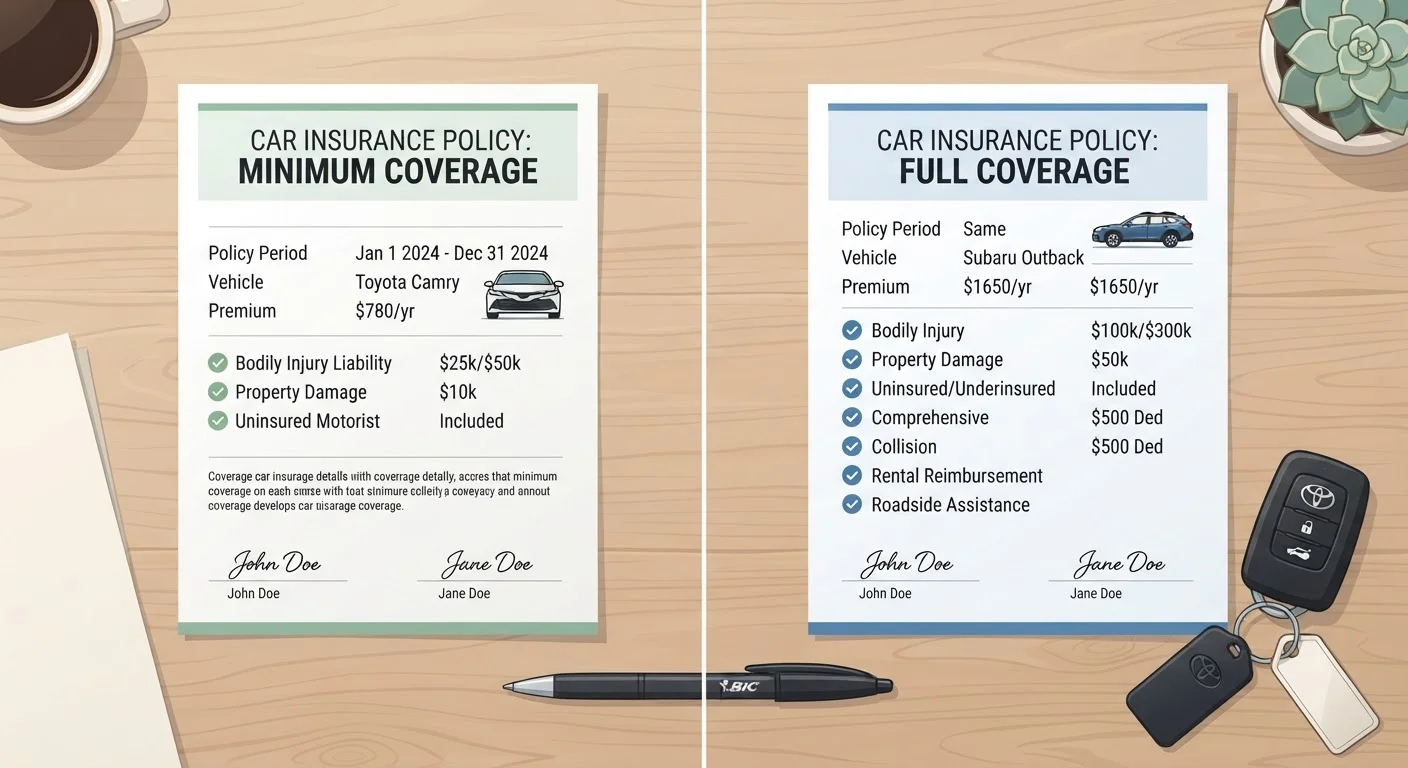
Photo credit: QuickInsights.net
In this article
Meeting your state's minimum requirement keeps you legal, but is it enough? Explore the real differences between minimum and full coverage.
Key Takeaways
- State minimum coverage only pays for damage or injuries you cause to others - your own vehicle is not protected.
- Full coverage typically adds collision and comprehensive, protecting your car from accidents, theft, and weather events.
- Lenders almost always require full coverage on financed or leased vehicles.
- The right choice depends on your vehicle's value, your savings, and your tolerance for financial risk.
- State minimums vary widely - carrying only the legal floor can leave significant gaps after a serious accident.
What State Minimum Coverage Actually Includes
Every state except New Hampshire mandates that drivers carry at least a minimum level of auto insurance. In practice, that almost always means liability coverage - which breaks into two components: bodily injury liability and property damage liability.
Bodily injury liability pays for medical expenses, lost wages, and legal costs for other people injured in an accident you cause. Property damage liability covers repair or replacement costs for another person's vehicle or property you damage.
What's conspicuously absent: any protection for your own vehicle or your own medical bills. If you cause a crash and your car is totaled, state minimum coverage leaves you paying those costs entirely out of pocket. See our overview of core coverage types for a plain-language explanation of how each layer works.
State minimums also vary dramatically. One state might require $25,000 per person in bodily injury coverage; another may set the floor at $15,000. These limits can be exhausted quickly in a serious accident, leaving you personally liable for any amount above the limit.
Minimum Limits Can Be Exhausted Quickly
A moderate injury accident involving emergency care, surgery, and lost wages can easily exceed $100,000 in costs. If your state minimum bodily injury limit is $25,000 per person, you could be personally responsible for any amount above that threshold. Many financial advisors recommend carrying liability limits well above the state minimum for this reason, regardless of whether you add collision or comprehensive.
What "Full Coverage" Really Means
"Full coverage" is an industry shorthand, not a defined policy type. In common usage it refers to a policy that combines the state-required liability coverage with two additional layers:
- Collision coverage: Pays to repair or replace your vehicle after a crash, regardless of who is at fault.
- Comprehensive coverage: Covers losses from non-collision events - theft, vandalism, fire, flooding, hail, and animal strikes.
Together, these three elements protect both other parties and your own vehicle. For a deeper look at how collision and comprehensive differ from each other, see our breakdown of collision vs. comprehensive.
Full coverage policies also commonly include uninsured/underinsured motorist coverage and medical payments coverage, though whether these are bundled in or added separately depends on the insurer and the state. Our auto insurance primer walks through every major component.
| Criterion | State Minimum Coverage | Full Coverage |
|---|---|---|
| Legally required | Yes (in most states) | No (unless lender requires) |
| Covers damage you cause others | Yes | Yes |
| Covers your vehicle in a crash | No | Yes (collision) |
| Covers theft or weather damage | No | Yes (comprehensive) |
| Required for financed vehicles | No | Yes, typically |
| Monthly premium | Lower | Higher |
| Out-of-pocket risk after a crash | Higher | Lower (subject to deductible) |
The Financial Trade-Off: Cost vs. Risk
The core tension is straightforward: state minimum coverage costs less every month, but exposes you to larger potential losses. Full coverage costs more, but caps the financial damage from a wide range of incidents.
Premium differences vary by driver profile, location, vehicle, and insurer - but full coverage policies commonly cost anywhere from 50% to more than double what a minimum-only policy runs. That gap narrows in absolute dollar terms for older, lower-value cars.
The standard rule of thumb financial planners often cite: if your annual collision and comprehensive premium exceeds 10% of your vehicle's current market value, the math starts to favor dropping those coverages. That said, your personal savings cushion matters just as much - someone without liquid reserves to cover a $5,000 repair may rationally choose full coverage even on a modest vehicle.
~13%
Estimated uninsured drivers on U.S. roads
According to the Insurance Research Council, roughly 1 in 8 drivers lacked insurance in a recent study period - a key reason uninsured motorist coverage matters even for drivers with full coverage.
Varies by state
State minimum bodily injury limits
The Insurance Information Institute notes that minimum bodily injury limits range from $15,000 per person in some states to $50,000 or more in others, meaning the legal floor offers very different protection depending on where you live.
Drivers considering dropping optional coverages on aging vehicles will find a structured framework in our guide on when dropping coverage makes sense. And before assuming your existing policy has you covered, it's worth reviewing common coverage gaps that surface after accidents.
This article is for general informational purposes only and does not constitute personalized insurance or financial advice. Coverage requirements, terms, and costs vary by state and insurer. Consult a licensed insurance agent or adviser to evaluate options appropriate to your specific situation.

Author
Autos & Vehicles Editorial Team
Autos & Vehicles Editorial Team is the collective byline for our editorial team and contributor network. Articles published under this byline or an editorial pen name are researched, written, and reviewed according to our editorial standards for clarity, consistency, and independence before publication.
View all articles →