
Liability, Collision, and Comprehensive: The Core Coverage Types Explained
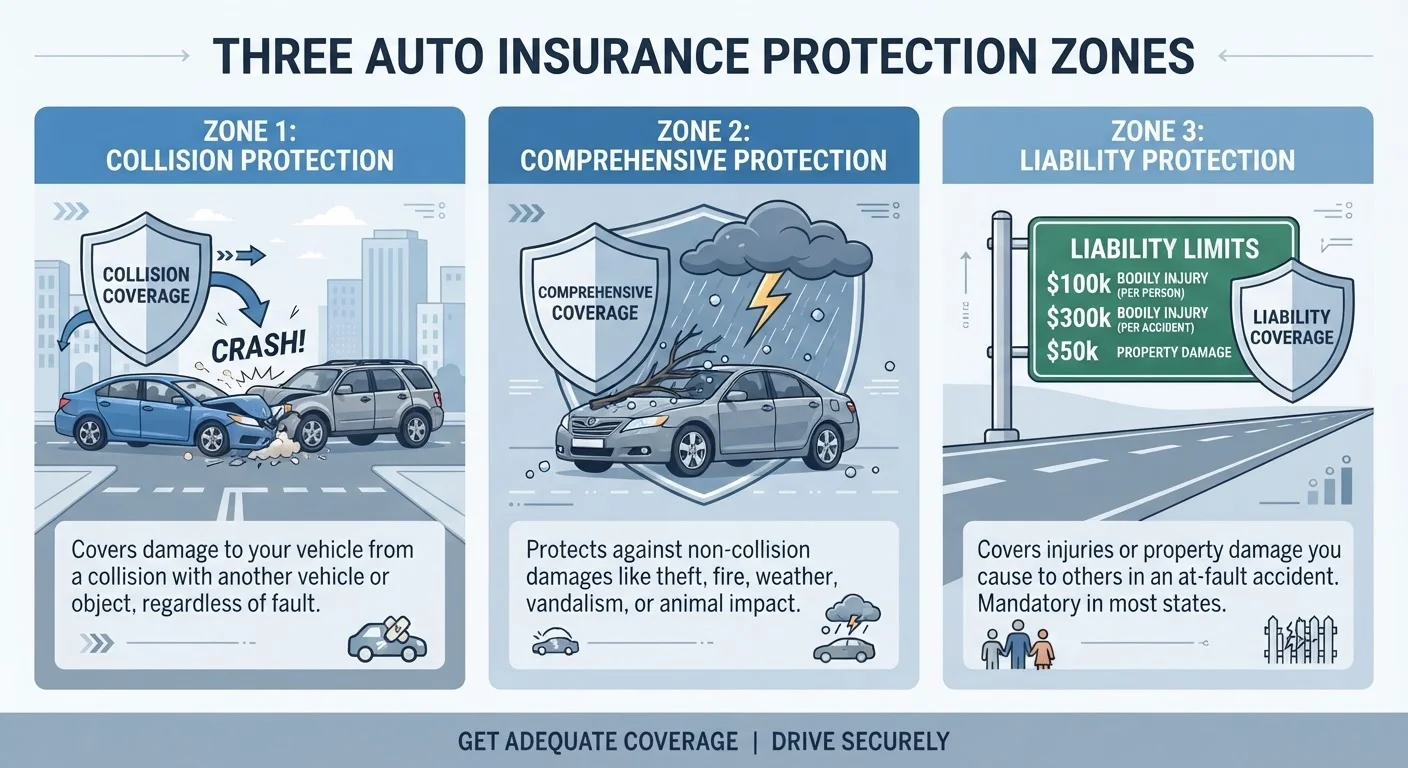
Photo credit: QuickInsights.net
In this article
Understand the three foundational auto insurance coverages, what each one protects against, and how they work together.
Key Takeaways
- Liability coverage is legally required in nearly every U.S. state and protects other people, not your vehicle.
- Collision coverage pays for damage to your own car after a crash, regardless of who is at fault.
- Comprehensive coverage handles non-collision events: theft, hail, flooding, fire, and animal strikes.
- Lenders and lessors typically require both collision and comprehensive on financed or leased vehicles.
- Each coverage type has its own limits and, for collision and comprehensive, a separate deductible.
- Carrying only the state minimum liability may leave significant out-of-pocket exposure after a serious accident.
Liability Coverage: The Legal Foundation
Liability insurance is the coverage required by law in almost every U.S. state. It pays for the bodily injury and property damage you cause to others when you are at fault in an accident. It does not cover your own vehicle, your own injuries, or damage to your property.
Policies express liability limits in two ways. Split limits - such as 25/50/25 - mean $25,000 per injured person, $50,000 per accident for all bodily injuries combined, and $25,000 for property damage. A combined single limit provides one pool of funds for all damage and injury in a single incident.
State-mandated minimums are often lower than what a serious accident actually costs. A multi-car pileup or a pedestrian injury can generate medical bills and legal liability well into six figures. Drivers who carry only the minimum are personally responsible for costs that exceed their limits. Reviewing your liability limits against your personal financial exposure - assets, income, savings - is a practical first step before locking in a policy. For a broader look at how these pieces fit together, see Auto Insurance Decoded.
~13%
Estimated share of U.S. drivers uninsured
According to the Insurance Research Council, roughly 1 in 8 drivers on U.S. roads carries no auto insurance, reinforcing why adequate liability limits and uninsured motorist coverage both matter.
$5,000-$15,000+
Typical range for collision repair costs
The National Safety Council and industry repair data indicate that moderate-to-severe collision damage frequently exceeds several thousand dollars, making collision coverage financially significant for most owners.
49 states
States requiring minimum liability insurance
All U.S. states except New Hampshire require drivers to carry minimum liability coverage (New Hampshire requires proof of financial responsibility in lieu of mandatory insurance).
Collision Coverage: Protecting Your Own Vehicle After a Crash
Collision coverage pays for repairs to your vehicle when it is damaged in a collision - with another car, a guardrail, a parking structure, or any other object - regardless of who caused the accident. If the other driver is at fault, your insurer may pursue reimbursement from the other party's liability insurer through a process called subrogation, but collision coverage lets your claim proceed without waiting for that outcome.
This coverage is subject to a deductible you choose when you set up your policy. Common deductibles run from $250 to $1,500. A higher deductible lowers your monthly premium but means more out-of-pocket cost when a claim occurs. If repair costs are lower than your deductible, filing a claim offers no financial benefit.
Lenders and leasing companies require collision coverage on any financed or leased vehicle because the vehicle serves as collateral on the loan. Once a vehicle is owned outright, carrying collision becomes a personal financial decision rather than a contractual obligation. When dropping collision coverage makes sense depends largely on your vehicle's current market value relative to what you pay in premiums and stand to lose in a deductible.
Comprehensive Coverage: When It's Not a Crash
Comprehensive coverage - sometimes called "other than collision" - pays for physical damage to your vehicle from events that do not involve hitting something. Common covered events include theft, vandalism, fire, flooding, hail, falling objects, and collisions with animals (hitting a deer, for example, is typically a comprehensive claim, not a collision claim).
Like collision, comprehensive carries a deductible and is often required by lenders on financed vehicles. The two are frequently bundled together, though each is technically a separate coverage that can be purchased independently.
Drivers sometimes confuse comprehensive with full coverage - a term insurers don't formally define. "Full coverage" is informal shorthand for a policy that includes liability, collision, and comprehensive together. It doesn't mean everything is covered; exclusions still apply, and other coverage types like medical payments, uninsured motorist, or roadside assistance are separate add-ons. For a side-by-side breakdown of how collision and comprehensive differ from each other, see Collision vs. Comprehensive Coverage.
"Full Coverage" Is Not a Policy Term
Insurers do not use "full coverage" as an official category. When dealers, lenders, or agents say a vehicle requires "full coverage," they typically mean collision and comprehensive in addition to liability. Always ask which specific coverages are required and confirm the required deductible limits in writing.
How the Three Coverages Work Together
Each of the three core coverages addresses a different type of risk. Liability protects other people from financial harm you cause. Collision and comprehensive protect your own vehicle from different kinds of physical loss. A policy that includes all three provides substantially broader protection than the legal minimum alone.
Understanding where each ends matters just as much as knowing what each covers. Liability won't repair your car. Collision won't help if your car is stolen. Comprehensive won't apply if you rear-end someone. Knowing these boundaries helps you identify coverage gaps that could leave you exposed before a claim reveals them.
Optional endorsements - GAP insurance, rental reimbursement, roadside assistance - layer on top of these three core types to fill specific gaps. See Add-On Coverages Worth Understanding for what these add-ons actually do and when they're worth considering.
This article is for general informational purposes only and does not constitute personalized insurance advice. Coverage terms, requirements, and exclusions vary by insurer and state. Consult a licensed insurance agent or adviser for guidance specific to your situation and review your actual policy documents carefully before making coverage decisions.
Frequently Asked Questions

Author
Autos & Vehicles Editorial Team
Autos & Vehicles Editorial Team is the collective byline for our editorial team and contributor network. Articles published under this byline or an editorial pen name are researched, written, and reviewed according to our editorial standards for clarity, consistency, and independence before publication.
View all articles →