
Collision vs. Comprehensive Coverage: What Sets Them Apart
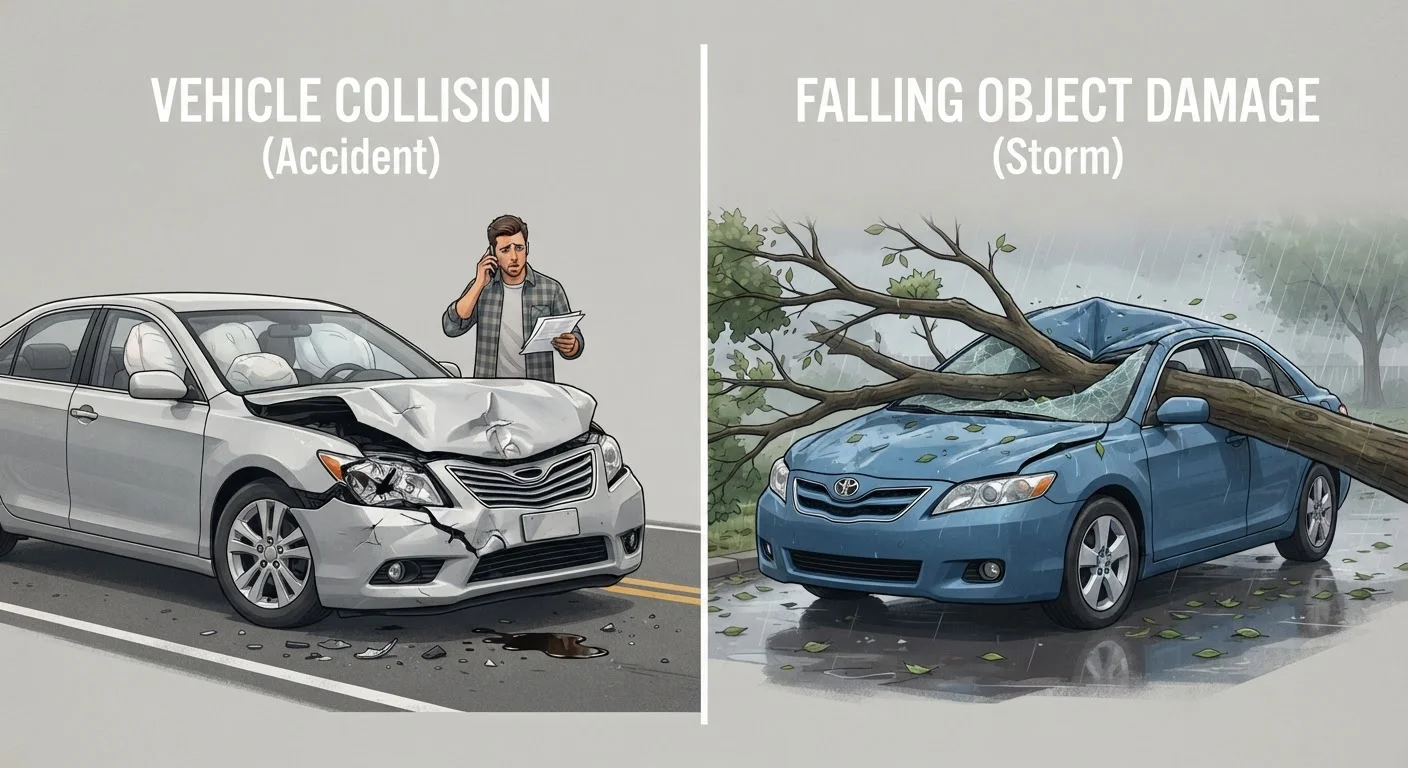
Photo credit: QuickInsights.net
In this article
Collision and comprehensive are often confused. Here's a clear breakdown of what each covers and when you might need both.
Key Takeaways
- Collision coverage pays for damage caused by accidents with other vehicles or stationary objects.
- Comprehensive coverage pays for damage from events like theft, hail, floods, fires, and animal strikes.
- Neither coverage is legally required by any state, but lenders typically require both on financed vehicles.
- Both coverages carry a deductible - the amount you pay out of pocket before the insurer covers the rest.
- Carrying both together is often called 'full coverage' alongside liability, though the term has no standard legal definition.
- Whether to keep either coverage depends largely on your vehicle's current market value.
How Each Coverage is Defined
Collision coverage pays to repair or replace your vehicle when it's damaged as a result of hitting another vehicle, being hit by another vehicle, or striking a stationary object - such as a guardrail, utility pole, or parking barrier. It applies regardless of who caused the accident, though your insurer may seek reimbursement from the at-fault driver's insurance through a process called subrogation.
Comprehensive coverage (sometimes called "other than collision" in policy documents) pays for damage to your vehicle caused by events that aren't classified as a collision. Covered events typically include: theft, vandalism, hail and windstorm damage, flooding, fire, falling objects (such as tree limbs), and striking an animal. If a deer runs into your vehicle, that's a comprehensive claim - not a collision claim, even though physical impact occurred.
A practical way to remember the difference: collision involves your car's movement into or against something; comprehensive covers damage that happens to your parked or moving car from outside forces you generally can't control.
For a broader look at how these fit alongside liability coverage, see the three core coverage types explained.
Key Differences at a Glance
The table below summarizes the most important distinctions between the two coverage types. Both share the same basic mechanics - a deductible applies before the insurer pays - but they respond to entirely different categories of risk.
| Criterion | Collision Coverage | Comprehensive Coverage |
|---|---|---|
| What triggers a claim | Your car hits or is hit by a vehicle or object | Non-collision events: theft, weather, animals, fire |
| Legally required | No (lenders may require it) | No (lenders may require it) |
| Typical deductible range | $250-$1,500+ | $100-$1,500+ |
| Relative premium cost | Generally higher | Generally lower |
| Payout basis | Actual cash value (ACV) | Actual cash value (ACV) |
| Covers a deer strike | No | Yes |
| Covers at-fault accident damage | Yes | No |
| Covers hail or flood damage | No | Yes |
One point worth noting: both coverages pay based on your vehicle's actual cash value (ACV) at the time of the loss, not its original purchase price. ACV accounts for depreciation, so a three-year-old vehicle will typically receive a lower payout than its original sticker price would suggest.
Deductibles, Premiums, and the Cost Trade-Off
Both collision and comprehensive coverages require you to select a deductible - commonly ranging from $250 to $1,500 or more. The higher your deductible, the lower your premium, and vice versa. Choosing the right deductible is a balancing act: a low deductible costs more monthly but reduces your out-of-pocket expense if you file a claim; a high deductible lowers your premium but means you absorb more cost after a loss.
~$522/yr
Average U.S. collision coverage cost
According to the National Association of Insurance Commissioners (NAIC), average collision coverage expenditure for U.S. drivers was approximately $522 annually in recent reporting periods.
~$172/yr
Average U.S. comprehensive coverage cost
NAIC data shows comprehensive coverage costs U.S. drivers considerably less than collision on average, reflecting the different risk profiles of each coverage type.
$500
Most common deductible chosen by drivers
Industry surveys consistently show $500 as the most frequently selected deductible for both collision and comprehensive coverages among American policyholders.
Comprehensive coverage tends to carry a lower premium than collision coverage, reflecting the fact that many comprehensive events - particularly theft and weather - occur less predictably and often less frequently than traffic accidents for the average driver. However, in regions with high vehicle theft rates or frequent severe weather, comprehensive premiums can be higher than typical.
For more context on how coverage choices affect overall policy costs, weighing state minimum versus full coverage is a useful next read.
When You Need One, Both, or Neither
No state mandates either collision or comprehensive coverage as part of its minimum insurance requirements. However, if you're financing or leasing your vehicle, your lender will almost certainly require both - they have a financial stake in the car and need protection if it's totaled or stolen.
If you own your vehicle outright, the decision is yours. A commonly used rule of thumb: if your annual premium for a coverage type exceeds roughly 10% of your vehicle's current market value, the coverage may no longer be cost-effective. This isn't a guarantee of the right choice for every situation, but it provides a starting framework.
Drivers who only carry liability coverage - meeting their state's legal minimum - have no protection for their own vehicle in an accident they cause, or if their car is stolen or damaged by a storm. Understanding these coverage gaps that leave drivers exposed is critical before deciding to drop either coverage.
For a full orientation to how all auto insurance coverages work together, Auto Insurance Decoded covers the complete picture in plain language.
What 'Full Coverage' Actually Means
You'll often hear the phrase 'full coverage' used to describe a policy that includes liability, collision, and comprehensive. However, 'full coverage' is not a defined term in any state's insurance regulations - it's informal shorthand. A policy described this way still has exclusions, limits, and deductibles. Always review the actual declarations page of your policy to understand exactly what is and isn't covered.
This article is for general informational purposes only and does not constitute personalized insurance advice. Coverage terms, exclusions, and costs vary by insurer, policy, and state. Always read your policy documents carefully and consult a licensed insurance agent for guidance specific to your situation.

Author
Autos & Vehicles Editorial Team
Autos & Vehicles Editorial Team is the collective byline for our editorial team and contributor network. Articles published under this byline or an editorial pen name are researched, written, and reviewed according to our editorial standards for clarity, consistency, and independence before publication.
View all articles →