
Private Seller vs. Dealership: What Changes About the Buying Process
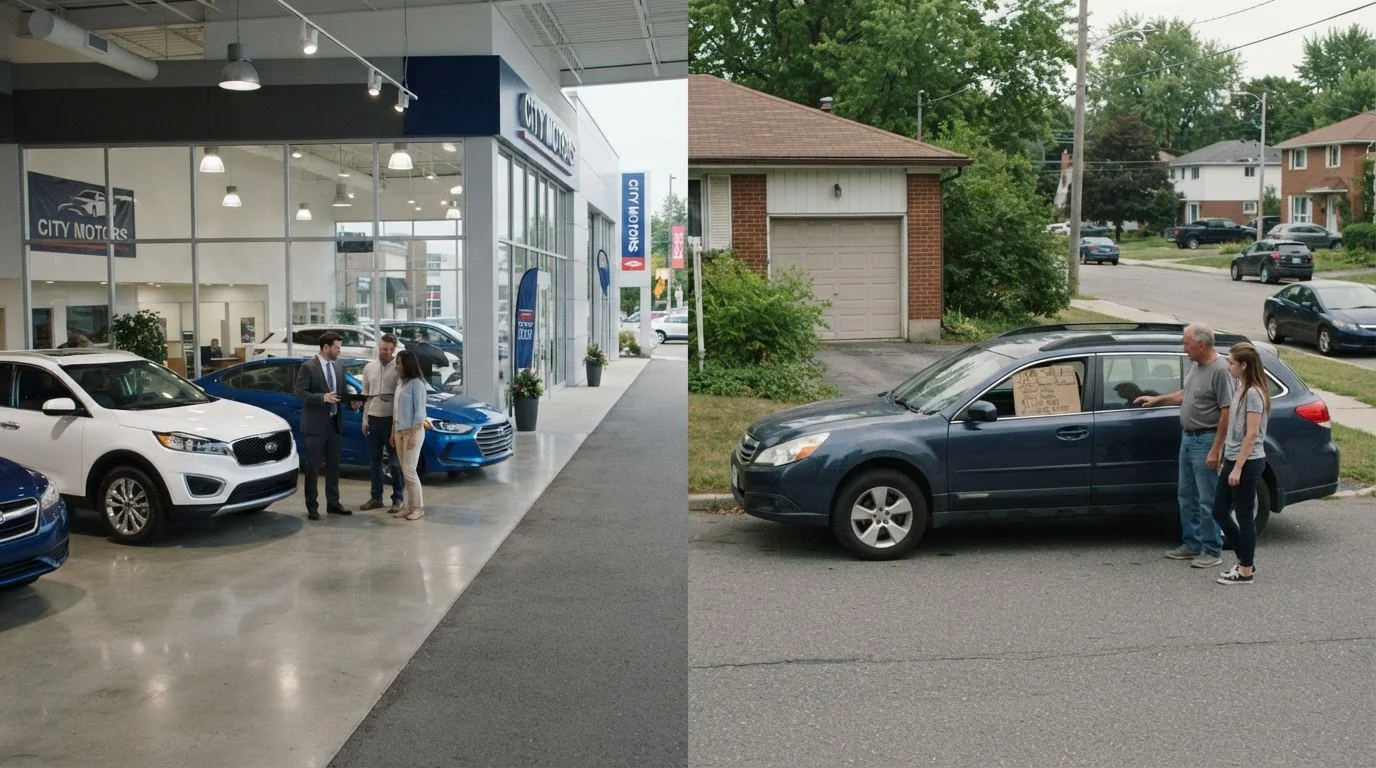
Photo credit: QuickInsights.net
In this article
Price, paperwork, legal protections, and risk profiles all shift depending on who you buy from. Here's what each path involves.
Key Takeaways
- Private sellers typically offer lower prices but come with no warranties, limited legal recourse, and more paperwork for the buyer.
- Dealerships provide financing options, trade-in handling, and consumer protections, but add fees and sales pressure to the process.
- Title transfer and state registration requirements are the buyer's responsibility in a private sale; dealers usually handle this.
- A pre-purchase inspection by an independent mechanic is essential when buying from a private seller.
- Neither channel is universally better - the right choice depends on your budget, risk tolerance, and time available.
How Price and Negotiation Differ
Private sellers generally list vehicles below dealership prices because they carry no overhead - no lot fees, no reconditioning costs, no commission structures. That gap can range from a few hundred to several thousand dollars depending on the vehicle and market conditions. However, the listed price isn't always the transaction price. Private sellers are often motivated to sell quickly, which can create negotiating room - but unlike dealers, they also have no obligation to accept a reasonable offer or disclose a competing bid.
Dealers price vehicles to cover acquisition, reconditioning, and overhead, then add margin. That built-in cost structure is why sticker prices run higher. What dealers offer in return is the ability to bundle financing, trade-in credit, and optional add-ons - all in one transaction. Understanding how these layers interact is important; see our guide on moments where buyers lose ground for a closer look at where the numbers can slip.
| Private Seller | Dealership | |
|---|---|---|
| Typical Price | Generally lower | Generally higher due to overhead |
| Warranty | None (as-is in most cases) | As-is or dealer/manufacturer warranty |
| Lemon Law Protection | Rarely applies | Applies in most states for used cars |
| Title & Registration | Buyer handles independently | Dealer processes on buyer's behalf |
| Financing Available | Buyer must arrange externally | On-site financing available |
| Trade-In Option | Not applicable | Accepted and applied to purchase |
| Inspection Responsibility | Buyer arranges independent mechanic | Some reconditioning done; inspection still advisable |
Legal Protections and Warranty Coverage
This is where the two paths diverge most significantly. A private sale is typically an as-is transaction - once signed, the seller bears no responsibility for mechanical problems that surface afterward, unless fraud or deliberate concealment can be proven. Most states do not extend lemon law protections to private sales. If the engine fails three days after purchase, the loss is yours.
Dealerships selling used vehicles are generally required to disclose whether a car is being sold as-is or with a warranty. Federal used-car rules (the FTC Buyers Guide) require dealers to display warranty terms or an as-is designation on every used car. Certified pre-owned vehicles carry manufacturer-backed warranties - a meaningful distinction for buyers who want coverage. That said, dealer warranties vary in scope, so read the terms rather than assume.
Never Skip the VIN Check or Independent Inspection
In a private sale, there is no consumer safety net after money changes hands. Always obtain a vehicle history report and have the car inspected by a mechanic you hire - not one recommended by the seller. If a seller refuses to allow an inspection, treat that as a significant warning sign and walk away.
Paperwork and Title Transfer
Buying from a dealer is administratively simpler. The dealership handles the title transfer, submits paperwork to the state DMV on your behalf, and often provides temporary tags so you can drive immediately. You sign in the finance office and leave with a vehicle - the bureaucratic steps happen behind the scenes.
A private sale puts that burden on the buyer. You'll need a signed title from the seller (verify it's lien-free before handing over money), a bill of sale, proof of insurance, and the appropriate state registration forms. Some states require a notarized title or a smog/emissions certificate. Paying off an existing lien on a private-seller vehicle requires coordinating with the seller's lender - a process that can take days and adds complexity. Checking your state DMV's requirements before closing is non-negotiable.
If you're also financing the purchase through your own lender rather than a dealer, the process differs further. Our article on financing through a dealership vs. your own bank explains what to expect on both paths.
Due Diligence: What Each Path Demands From You
With a private seller, due diligence falls entirely on the buyer. At minimum, this means pulling a vehicle history report using the VIN, arranging a pre-purchase inspection with an independent mechanic, and confirming the seller's identity matches the title. Skipping the inspection is one of the most common and costly mistakes buyers make in private transactions.
Dealers are not exempt from scrutiny, but they do offer more built-in checkpoints. Many recondition vehicles, and certified pre-owned programs include multi-point inspections. Still, dealer reconditioning is not a substitute for an independent inspection - their technicians are assessing what to fix to make a car saleable, not necessarily what a buyer would want to know. For a breakdown of dealer add-ons that get pitched at signing, see add-ons dealerships often pitch - some carry genuine value, others don't.
If you're trading in a vehicle, that transaction only happens at a dealership. Understanding how trade-in figures are calculated helps you evaluate whether the offer is fair - our piece on the trade-in process walks through the logic behind those numbers.

Author
Autos & Vehicles Editorial Team
Autos & Vehicles Editorial Team is the collective byline for our editorial team and contributor network. Articles published under this byline or an editorial pen name are researched, written, and reviewed according to our editorial standards for clarity, consistency, and independence before publication.
View all articles →