
Financing Through a Dealership vs. Your Own Bank: How the Numbers Differ
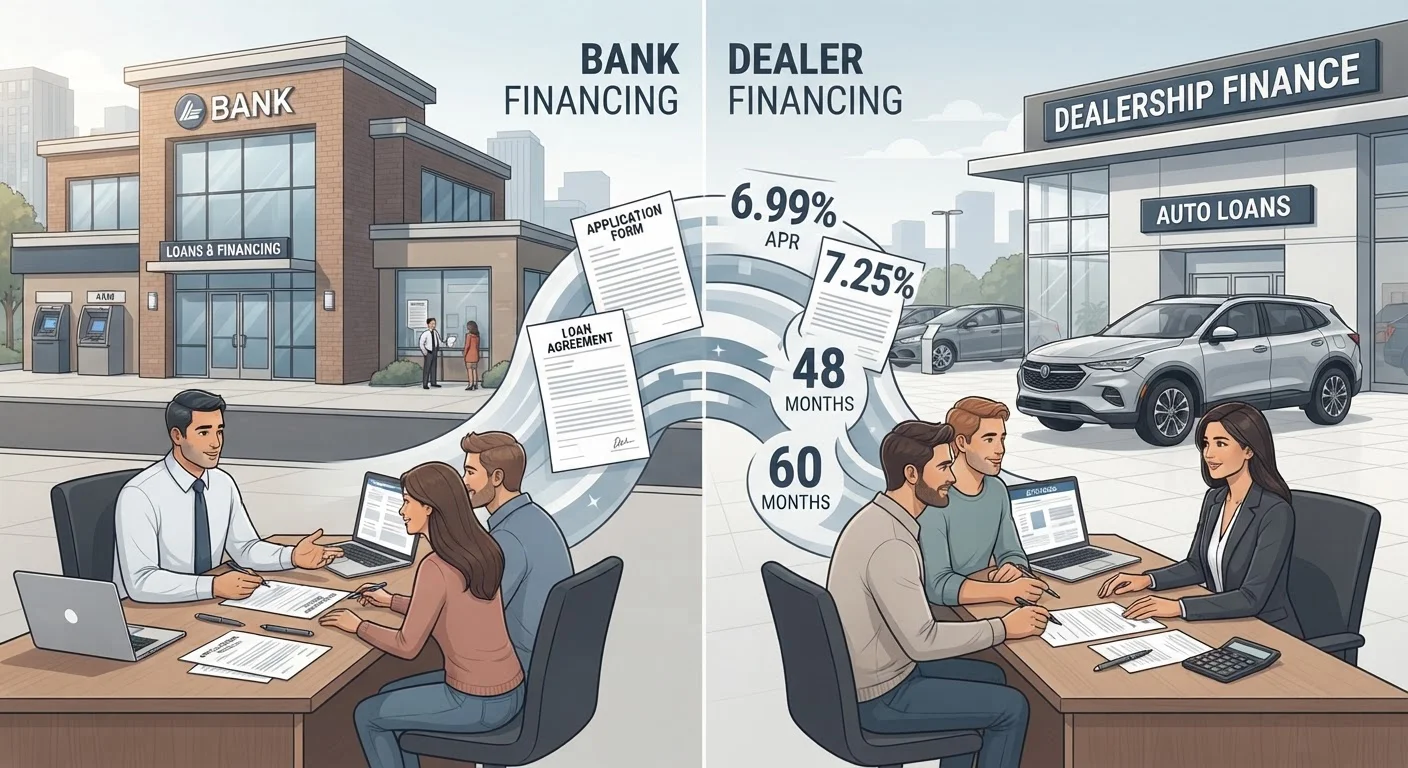
Photo credit: QuickInsights.net
In this article
Dealer-arranged loans and direct bank financing work very differently. Understanding both helps you borrow on better terms.
Key Takeaways
- Dealers act as middlemen with lenders, sometimes marking up the rate above what a lender actually requires.
- Getting pre-approved by your own bank or credit union before visiting a dealership gives you a concrete benchmark rate.
- Manufacturer-subsidized financing offers (0% or low APR) can be genuine savings, but typically require excellent credit.
- Credit unions consistently offer competitive auto loan rates for their members compared to many retail lenders.
- The loan amount, not just the monthly payment, is what you should focus on when comparing financing sources.
- Shopping multiple lenders within a short window typically counts as a single credit inquiry under most scoring models.
How Each Financing Path Actually Works
When you finance at a dealership, the dealer doesn't lend you money directly. Instead, the finance and insurance (F&I) office submits your application to a network of third-party lenders - banks, captive finance arms (the automaker's own lending subsidiary), and other institutions. Those lenders respond with a buy rate: the minimum interest rate they'll accept for your loan. The dealer is then free to present you a higher rate, keeping the difference as dealer reserve, a form of compensation built into the financing.
When you finance through your own bank or credit union, you negotiate directly with the lender. There is no intermediary earning a spread. The rate you're offered is the rate the lender actually intends to charge - not a marked-up version of it. Once approved, you receive a pre-approval letter or a blank check up to a specified amount that you bring to the dealership.
Understanding how your credit score affects your loan rate matters in both scenarios - lenders use it to set that buy rate, and dealers use it to determine how much markup the market will bear.
The Rate Markup: What It Costs in Real Dollars
| Criterion | Dealership Financing | Direct Bank / Credit Union |
|---|---|---|
| Who sets your rate | Third-party lender, marked up by dealer | Lender quotes you directly |
| Rate transparency | Buy rate often not disclosed | Quoted rate is your actual rate |
| Convenience | Single-stop at dealership | Requires advance application |
| Lender access | Broad network, including non-prime | One lender per application |
| Rate potential (excellent credit) | Competitive if manufacturer-subsidized | Often lower than retail dealer rate |
| Private-party purchase | Not available | Available with proper documentation |
| Negotiating position | Rate set after vehicle selection | Rate locked before you shop |
Dealer reserve markups are capped by many lenders - commonly at 1 to 2.5 percentage points above the buy rate - but even a modest markup compounds meaningfully over a 60- or 72-month loan. On a $30,000 loan at 6% APR over 60 months, the total interest paid is approximately $4,799. At 7.5% - just 1.5 points higher - that rises to roughly $6,068. That $1,269 difference leaves the dealership, not your pocket.
Manufacturer-subsidized rates are the notable exception. When an automaker offers 0% or 1.9% financing on a specific model, that rate is genuinely subsidized - the manufacturer buys down the rate to move inventory. These offers are real, but they generally require a credit score well above 700 and may be paired with restrictions such as shorter loan terms or exclusion of certain trim levels. Always confirm whether accepting the subsidized rate means forgoing a cash-back rebate, which sometimes produces a better outcome depending on your situation.
1-2.5%
Typical dealer rate markup range above buy rate
The Consumer Financial Protection Bureau has documented that dealer reserve markups commonly fall within this range, though individual lender caps vary.
$1,000+
Additional interest from a 1.5-point rate increase on a $30K loan
On a 60-month, $30,000 loan, the difference between 6% and 7.5% APR amounts to roughly $1,269 in additional total interest paid.
14-45 days
Rate-shopping window treated as one credit inquiry
FICO and VantageScore models consolidate multiple auto loan inquiries made within this window into a single inquiry for scoring purposes.
Pre-Approval: Your Most Practical Negotiating Tool
Walking into a dealership with a pre-approval from your bank or credit union changes the dynamic of the financing conversation. You know your rate. You know your maximum loan amount. The dealer's F&I office must now beat that offer to earn your financing - which they sometimes can, because their lender network is broad. Either way, competition benefits you.
Pre-approval from a direct lender also separates the vehicle price negotiation from the financing discussion. Dealers profit when these conversations blur together - adjusting monthly payment figures up or down while changing loan terms in ways that obscure the actual cost. Keeping them distinct is a straightforward way to evaluate both on their own merits. See how to approach the price negotiation itself for strategies on that front.
One practical note: applying to multiple lenders within a short window - typically 14 to 45 days depending on the credit scoring model - is generally treated as a single hard inquiry for auto loan purposes. Rate shopping does not significantly harm your credit score when done within that window.
Be aware that the financing conversation is only one part of the dealership process. F&I offices also present add-on products such as extended warranties and gap insurance. Review which dealership add-ons carry genuine value before that meeting so you can evaluate each item on its own merits rather than under time pressure.
Credit Unions: Often the Overlooked Option
Credit union auto loan rates have consistently tracked below national bank averages for equivalent borrowers, according to data published by the National Credit Union Administration. Membership requirements vary - many are based on employer, location, or membership in an affiliated organization - but the application process is straightforward. If you're not already a member, it's worth investigating before committing to any financing source.
Which Path Fits Your Situation
Neither option is universally superior. The right answer depends on your credit profile, the specific vehicle, and what offers are available at the time of purchase.
If you belong to a credit union, start there. Credit unions are member-owned, carry lower overhead than commercial banks, and historically price auto loans below the national average rate for equivalent borrowers. If you don't belong to one, many allow you to join based on employer, geographic area, or professional affiliation.
If the dealer's network includes a lender with a lower rate than your pre-approval - and you've verified the full loan terms, not just the payment - accepting dealer financing is a rational choice. The goal is the lowest total cost of borrowing, regardless of which institution provides it.
For buyers considering a private-party purchase, dealer financing is simply unavailable. Your bank, credit union, or an online lender will need to fund that transaction. The private seller vs. dealership buying process article covers how this and other aspects of the transaction differ.
This article provides general financial information for educational purposes only. It is not personalized financial or lending advice. Loan terms, rates, and eligibility vary by lender, credit profile, and state. Consult directly with lenders and, where appropriate, a licensed financial adviser before making borrowing decisions.

Author
Autos & Vehicles Editorial Team
Autos & Vehicles Editorial Team is the collective byline for our editorial team and contributor network. Articles published under this byline or an editorial pen name are researched, written, and reviewed according to our editorial standards for clarity, consistency, and independence before publication.
View all articles →