
Renting vs. Buying a Home: Weighing the Real Trade-Offs
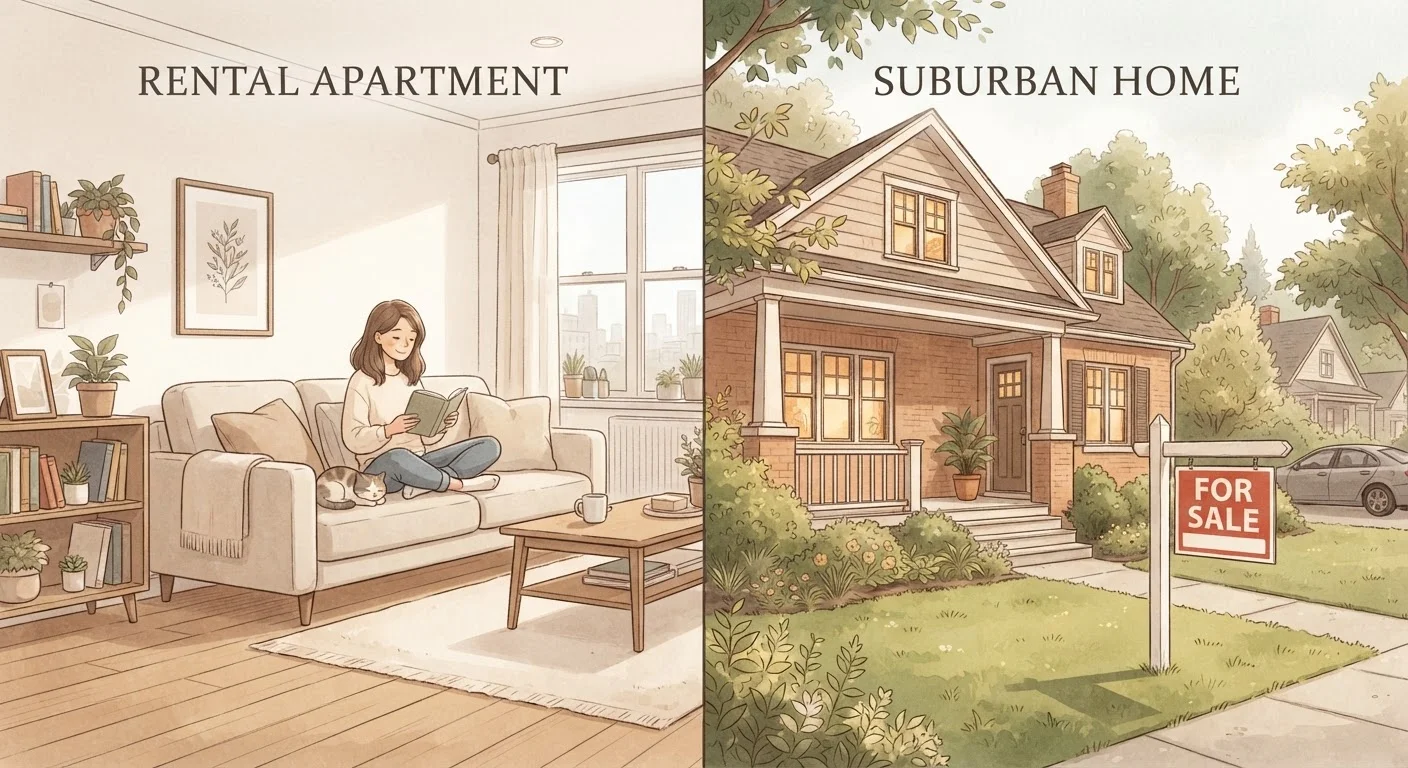
Photo credit: QuickInsights.net
In this article
Neither choice is universally better. This breakdown examines the financial, lifestyle, and timing factors that shape the decision.
Key Takeaways
- Buying builds equity over time but carries significant upfront and ongoing costs renters avoid.
- Renting offers flexibility and predictable monthly costs, but provides no ownership stake in the property.
- The financial case for buying typically strengthens the longer you plan to stay in one location.
- Local market conditions, your savings, and job stability all materially shape which option makes sense.
- Neither renting nor buying is universally superior - the right answer depends on your specific circumstances.
The Core Financial Difference
At its most basic, renting and buying represent two fundamentally different relationships with housing costs. Renters pay for the right to occupy a property without building any ownership stake. Buyers take on debt and ongoing costs in exchange for equity - a growing ownership interest in an asset that may appreciate over time.
What often surprises people is how expensive buying actually is in the short run. Beyond a down payment - typically between 3% and 20% of the purchase price - buyers absorb closing costs (generally 2%-5% of the loan amount), property taxes, homeowner's insurance, and maintenance. The full cost picture of homeownership frequently catches first-timers off guard. Annual maintenance alone is commonly estimated at 1%-2% of the home's value.
Renters, by contrast, face a known monthly payment with far fewer surprise costs. That predictability has real value - especially for households managing tight cash flow or building an emergency fund.
| Renting | Buying | |
|---|---|---|
| Upfront costs | Security deposit, first/last month | Down payment, closing costs (5-25%+ of price) |
| Monthly cost predictability | Fixed for lease term; may increase at renewal | Mortgage fixed; taxes/insurance can rise |
| Equity building | None | Gradual; front-loaded toward interest |
| Flexibility to relocate | High - typically 30-60 day notice | Low - selling takes months and costs money |
| Maintenance responsibility | Landlord handles most repairs | Owner bears full cost and responsibility |
| Exposure to market changes | Rent increases; no appreciation upside | Appreciation potential; also depreciation risk |
| Typical financial break-even | Immediate - no asset to recover costs | Often 5-7+ years depending on market |
The Equity Argument - and Its Limits
Homeownership is often framed as forced savings: every mortgage payment builds equity, whereas rent payments disappear. That's partially true, but it overstates the case. In the early years of a mortgage, the majority of each payment goes toward interest, not principal. Building meaningful equity takes time.
Appreciation is also not guaranteed. Home values can stagnate or decline, as many homeowners experienced during the 2008 housing crisis. Before assuming a purchase is an investment, it's worth reviewing common financing assumptions that cost buyers thousands.
There is a legitimate equity case for buying - particularly over a 7-to-10-year-plus horizon. But it requires staying put long enough for equity growth to outpace transaction costs (agent commissions, closing costs, moving expenses). If you sell within two or three years, the math often favors renting.
Use a Break-Even Calculator Before Deciding
Online rent-vs-buy calculators - many offered by nonprofit housing organizations and financial institutions - allow you to input local purchase prices, estimated rents, expected tenure, and assumed appreciation rates to estimate a genuine financial break-even point. Running this analysis for your specific market gives you a concrete anchor rather than relying on general rules. Revisit the numbers if your expected timeline changes significantly.
Flexibility vs. Stability
Renting's clearest advantage is mobility. A lease - typically 12 months - represents a far smaller commitment than a 30-year mortgage. For people navigating career transitions, relationships, or uncertain life plans, that optionality is worth real money.
Homeownership, conversely, anchors you. Selling a home is expensive and time-consuming. If your job requires relocation or your circumstances change quickly, being locked into a property can create financial and logistical stress.
Stability cuts the other direction: renters face rent increases at lease renewal and the possibility of a landlord selling or reclaiming the property. Long-term renters in appreciating markets have sometimes found their housing costs escalating significantly, with no asset to show for years of payments.
Your honest assessment of your likely time horizon - not your ideal one - is one of the most important inputs into this decision.
Market Conditions and the Price-to-Rent Ratio
One useful analytical tool is the price-to-rent ratio: divide the purchase price of a home by the annual rent for a comparable property. A ratio above 20 generally suggests renting is more cost-efficient; below 15, buying tends to pencil out more favorably. Between 15 and 20 is a gray zone where personal factors matter most.
This ratio varies dramatically by market. In some Sun Belt cities, purchase prices remain accessible relative to rents. In high-cost coastal metros, ratios frequently exceed 25 or 30, meaning you'd pay a substantial premium to own an equivalent home rather than rent it.
Before deciding, research local conditions rather than applying national generalizations. If you're also weighing how different loan structures affect your monthly payment, comparing 15- and 30-year mortgage terms can sharpen the financial picture considerably.
65.6%
U.S. homeownership rate
According to the U.S. Census Bureau, roughly two-thirds of American households own their home, a figure that has remained relatively stable in recent decades.
5-7 years
Typical buying break-even horizon
Housing economists commonly estimate that buyers need to remain in a home at least five to seven years before transaction costs are offset by equity and appreciation gains.
1%-2%
Annual maintenance as % of home value
A widely cited rule of thumb holds that homeowners should budget 1%-2% of their property's value each year for routine maintenance and repairs.
Timing, Readiness, and Separating Myths from Reality
Cultural narratives in the U.S. have long positioned homeownership as a milestone of financial success. That framing can push people to buy before they're financially prepared - a decision that can become genuinely costly. A clear-eyed look at homebuying myths helps separate social pressure from sound planning.
True readiness involves more than a down payment. Stable employment, a healthy credit score, low existing debt, and an emergency fund that survives a home purchase are all meaningful prerequisites. Buyers who stretch aggressively - depleting savings and taking on maximum debt - leave themselves vulnerable to any financial disruption.
Renting during a period when buying isn't the right fit is not failing - it's disciplined financial management. And if ownership is eventually the goal, that window of renting can be used to strengthen credit, grow savings, and research markets without the pressure of an active purchase.
Once you own, decisions about what to change or improve carry their own trade-offs - explored further in our piece on renovating for ROI versus personal enjoyment.
This article is for general informational and educational purposes only and does not constitute personalized financial, legal, or investment advice. Consult a qualified financial adviser or real estate professional regarding your specific situation.

Author
Real Estate Editorial Team
Real Estate Editorial Team is the collective byline for our editorial team and contributor network. Articles published under this byline or an editorial pen name are researched, written, and reviewed according to our editorial standards for clarity, consistency, and independence before publication.
View all articles →