
Hard Inquiries vs. Soft Inquiries: What Actually Dings Your Score
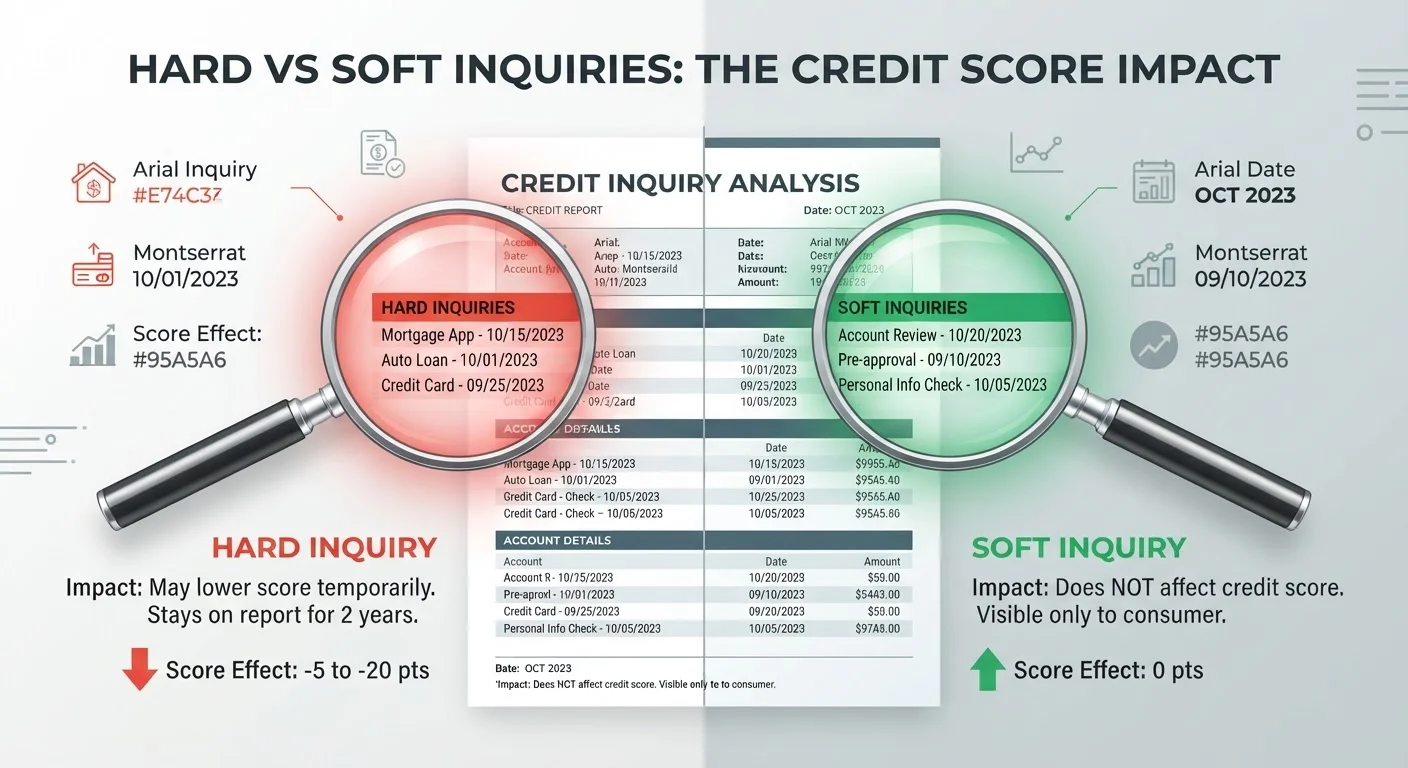
Photo credit: QuickInsights.net
In this article
Not all credit checks are equal. Learn the difference between hard and soft inquiries, which ones appear on your report, and how much they matter.
Key Takeaways
- Hard inquiries occur when you apply for new credit and can temporarily lower your score by a few points.
- Soft inquiries - like checking your own credit - never affect your credit score at all.
- Hard inquiries stay on your credit report for two years but typically influence your score for only 12 months.
- Rate shopping for mortgages or auto loans within a short window usually counts as a single inquiry.
- Multiple hard inquiries in a short period can signal financial stress to lenders and compound the score impact.
The Core Difference: Who's Asking and Why
A hard inquiry (sometimes called a hard pull) happens when a lender or creditor reviews your credit report as part of an application decision. Think: applying for a credit card, a personal loan, a mortgage, or an auto loan. You have to authorize it, and it shows up on your credit report - visible to other lenders.
A soft inquiry (soft pull) happens when someone checks your credit without it being tied to a formal credit application. Common soft inquiries include checking your own credit score, a landlord running a rental background check, a credit card company pre-screening you for an offer, or an employer running a routine background check. You may not even know some soft inquiries are happening.
The critical distinction: only hard inquiries can affect your credit score. Soft inquiries appear on your personal credit report for your own reference, but they are invisible to other lenders and carry no scoring weight whatsoever. For a deeper look at what else appears on your report, see what every section of your credit report signals to lenders.
| Criterion | Hard Inquiry | Soft Inquiry |
|---|---|---|
| Triggered by | Applying for new credit | Checking own credit; pre-screens; background checks |
| Affects credit score | Yes - typically a small, temporary dip | No - zero score impact |
| Visible to other lenders | Yes - appears on your credit report | No - only visible to you |
| Stays on report | Up to 2 years | Varies; not visible to lenders |
| Requires your authorization | Yes - you must apply or consent | Not always - pre-screens can happen without action |
| Score influence duration | Typically up to 12 months | None |
How Much Does a Hard Inquiry Actually Hurt?
The honest answer: usually not much on its own. A single hard inquiry typically drops a credit score by fewer than five points, according to FICO's published guidance. For most people in good standing, that's a minor, temporary dip.
~5 pts
Typical score drop per hard inquiry
FICO states that a single new hard inquiry generally lowers a score by fewer than five points for most consumers.
10%
Weight of inquiries in FICO score
The 'new credit' category - which includes hard inquiries - accounts for roughly 10% of a standard FICO score calculation.
2 years
How long hard inquiries stay on report
Hard inquiries remain on your credit report for two years, though most scoring models stop counting them after 12 months.
Hard inquiries remain on your credit report for two years, but their influence on your score generally fades after about 12 months. So the record stays, but the scoring sting doesn't last.
Where it gets more consequential is multiple hard inquiries in a short period. Several applications across different loan types - say, a car loan, a new credit card, and a personal loan - can signal to lenders that you're stretching your finances. The cumulative effect can be more noticeable. This is worth understanding before you apply for several things at once. For more on choices that quietly compound, see credit decisions that seem harmless but aren't.
One important exception: rate shopping. When you apply to multiple mortgage lenders or auto loan providers within a concentrated window (typically 14 to 45 days, depending on the scoring model), those inquiries are usually bundled and counted as one. Credit models recognize that comparison shopping for a single loan is financially savvy, not risky.
Inquiries also account for only about 10% of your overall FICO score. Your payment history and credit utilization ratio carry far more weight. To understand the full picture of how your score is calculated, see credit scores explained in plain language.
Practical Takeaways: Protecting Your Score
Knowing the difference lets you make smarter moves. A few principles worth keeping in mind:
- Pre-qualify before you apply. Many lenders offer a soft-pull pre-qualification that shows you estimated rates and terms. Use it to compare options before triggering any hard inquiry.
- Cluster rate shopping. If you're mortgage or auto loan shopping, do it within a tight window to take advantage of inquiry bundling in scoring models.
- Monitor freely. Checking your own credit score or pulling your own credit report - including through AnnualCreditReport.com - is always a soft inquiry. There's no reason to avoid it.
- Be selective with applications. Each hard inquiry is a signal. Apply for new credit when you need it, not speculatively.
Understanding how inquiries work is one piece of the broader puzzle. Your credit report and credit score serve different purposes - and understanding both helps you stay in control of your financial picture.
This article is for general informational purposes only and does not constitute personalized financial or credit advice. Consult a qualified financial professional for guidance specific to your situation.

Author
Personal Finance Editorial Team
Personal Finance Editorial Team is the collective byline for our editorial team and contributor network. Articles published under this byline or an editorial pen name are researched, written, and reviewed according to our editorial standards for clarity, consistency, and independence before publication.
View all articles →