
The Auto Insurance Terms Glossary Every Driver Should Bookmark
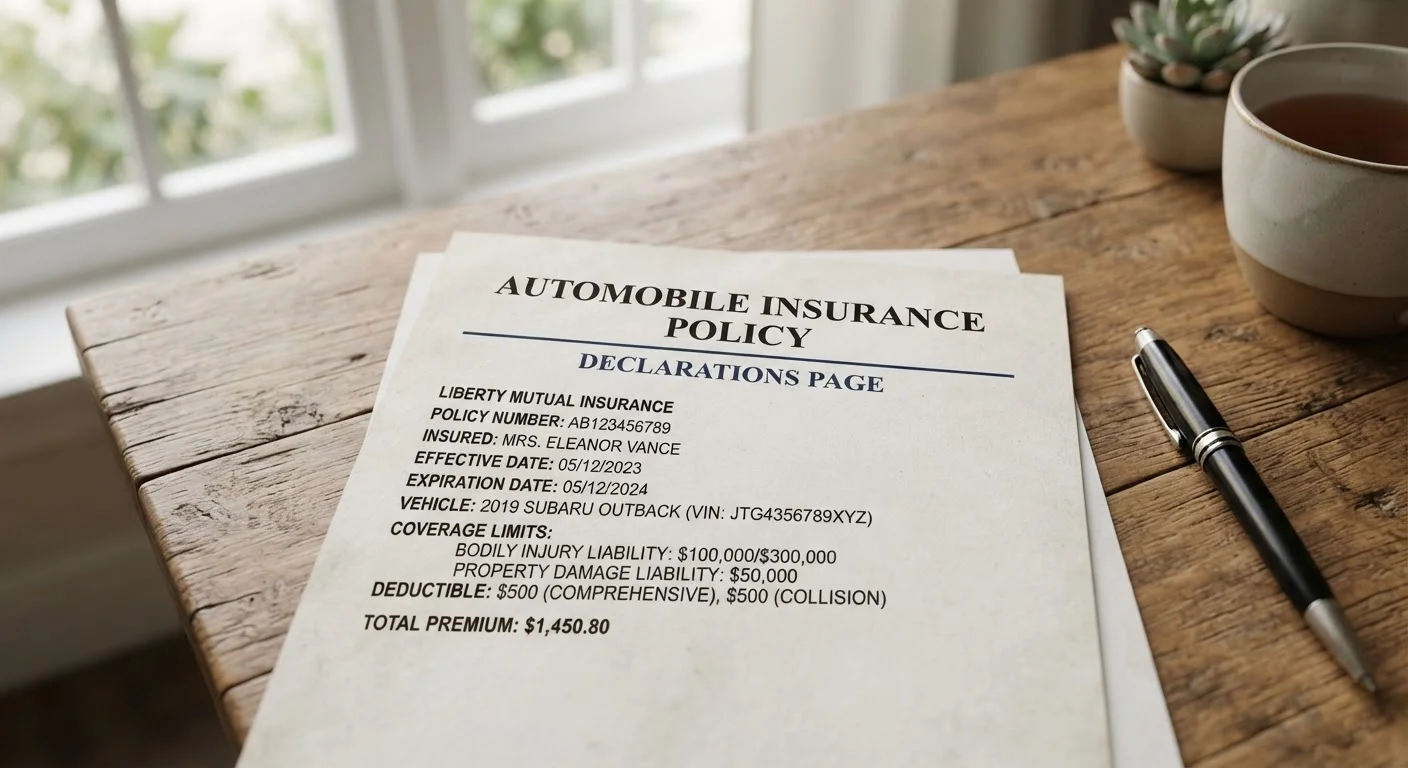
Photo credit: QuickInsights.net
In this article
Deductibles, premiums, subrogation, underinsured motorist — a plain-language reference to the terms that appear on every policy.
Why the Vocabulary Matters
Auto insurance policies are legally binding contracts, and the specific terms used carry precise meanings that directly affect what is - and isn't - covered when you file a claim. A driver who assumes comprehensive is synonymous with all-encompassing protection, for example, may be caught off guard to find it doesn't apply to a collision with another vehicle.
This glossary is a plain-language reference to the terms that appear in nearly every personal auto policy. Use it before signing up for a new policy, reviewing a renewal notice, or comparing quotes side by side. For a fuller breakdown of how each coverage type works in context, see our guide to what auto insurance actually covers and our walkthrough on reading a policy without getting lost.
| States requiring minimum liability coverage | 49 (New Hampshire allows an opt-out with proof of financial responsibility) (Insurance Information Institute) |
| Estimated share of U.S. drivers who are uninsured | Roughly 1 in 8 (Insurance Research Council estimate) |
| Typical deductible range | $250 to $1,000 |
| Average annual full-coverage premium (U.S.) | Approximately $2,000-$2,200 (National Association of Insurance Commissioners, 2023 data) |
Core Coverage and Policy Terms Defined
The terms below form the foundation of every personal auto policy. Knowing what each one means - and how they interact - helps you spot gaps before an accident forces the issue.
Premium
The amount you pay - monthly, semi-annually, or annually - to keep your policy active. Premiums are determined by factors such as your driving record, vehicle type, location, and selected coverage levels.
Deductible
The dollar amount you agree to pay out of pocket before your insurer covers the remainder of a claim. A $500 deductible on a $3,000 repair means you pay $500 and your insurer pays $2,500.
Liability Coverage
Pays for injuries and property damage you cause to others in an at-fault accident. Most states require a minimum level; carrying higher limits protects your personal assets from lawsuits.
Collision Coverage
Covers damage to your own vehicle resulting from a crash with another car or a stationary object, regardless of who is at fault. Subject to your chosen deductible.
Comprehensive Coverage
Pays for vehicle damage from non-collision events - theft, vandalism, fire, weather, or striking an animal. Also subject to a deductible, and often required by lenders on financed vehicles.
Uninsured/Underinsured Motorist (UM/UIM)
Protects you when you're struck by a driver who carries no insurance (UM) or too little insurance (UIM) to cover your damages. Required in some states, optional in others.
Declarations Page
The summary page at the front of your policy listing your name, covered vehicles, coverage types, limits, deductibles, and policy period. Often called the 'dec page' - it's the first place to check when reviewing a policy.
Coverage Limit
The maximum dollar amount your insurer will pay for a covered loss. Limits are often written as split limits (e.g., 100/300/100, representing thousands) or as a single combined limit for all damages per accident.
Exclusion
A specific condition, event, or type of damage your policy explicitly does not cover. Reading the exclusions section carefully helps prevent surprises when you file a claim.
Endorsement
An optional add-on that modifies or expands your base policy. Common examples include roadside assistance, rental reimbursement, and gap coverage. Also called a rider.
Subrogation
The legal process by which your insurer recovers money from a responsible third party - typically an at-fault driver's insurance company - after paying your claim. Policyholders are generally asked to cooperate but don't manage the process directly.
Actual Cash Value (ACV)
What your vehicle is worth at the moment of a covered loss, factoring in depreciation. This differs from replacement cost, which is what a comparable new or similar vehicle would cost to purchase.
Understanding Split Limits vs. Combined Single Limit
Liability limits are commonly expressed as three numbers - for example, 100/300/100. These represent (in thousands of dollars): the per-person bodily injury limit, the per-accident bodily injury limit, and the property damage limit. A combined single limit (CSL) instead sets one pool of funds for all damages arising from a single accident. Neither format is inherently superior - what matters is whether the total coverage is adequate given your assets and typical local claim costs.
For a deeper look at one of the most frequently overlooked protections on this list, our dedicated article on UM and UIM coverage explains when it applies and why it matters.
Claims Process Terms Worth Knowing
Beyond coverage types, a handful of terms describe how the claims process actually unfolds. Understanding them before you ever need to file can reduce confusion and help you advocate for a fair outcome.
- First-party claim: A claim you file with your own insurer - typically under collision, comprehensive, or medical payments coverage.
- Third-party claim: A claim filed against another driver's liability insurance by the person they injured or whose property they damaged.
- Total loss: When an insurer determines repair costs exceed a defined threshold - commonly 70-80% of the vehicle's actual cash value - the vehicle is declared a total loss and the ACV is paid out instead of repair costs.
- Gap coverage: An endorsement that pays the difference between your vehicle's ACV and what you still owe on a loan or lease. Particularly relevant for newer vehicles, which depreciate rapidly in the first few years of ownership.
- Subrogation: After settling your claim, your insurer may seek reimbursement from an at-fault party's carrier. You'll likely be asked to cooperate - such as not releasing a third party from liability - but you generally won't manage the process directly.
Once you're comfortable with this vocabulary, our guide to shopping for auto insurance without the overwhelm shows how to apply these concepts when comparing real quotes.

Author
Autos & Vehicles Editorial Team
Autos & Vehicles Editorial Team is the collective byline for our editorial team and contributor network. Articles published under this byline or an editorial pen name are researched, written, and reviewed according to our editorial standards for clarity, consistency, and independence before publication.
View all articles →