
Understanding Compound Interest on Both Sides of the Ledger
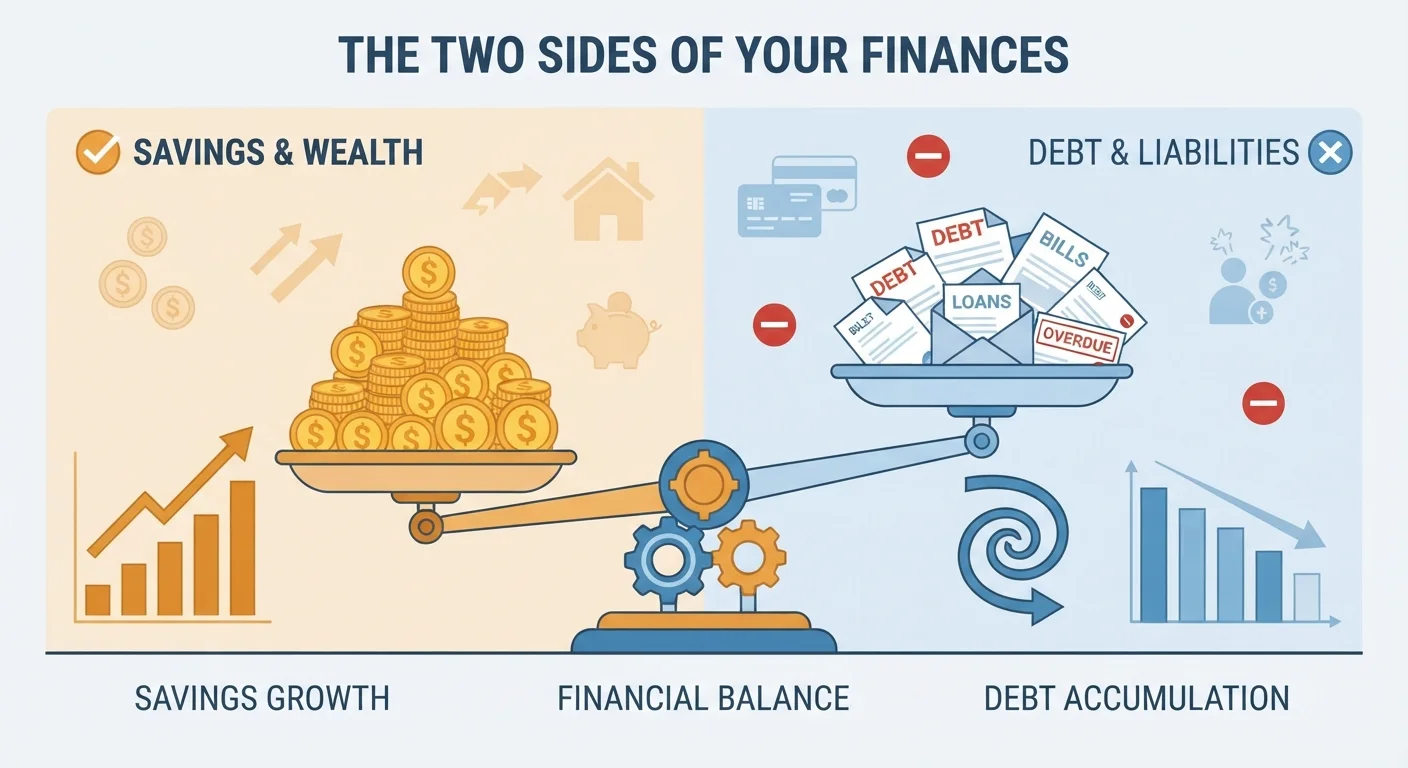
Photo credit: QuickInsights.net
In this article
Compound interest grows your savings—and your debt. This guide explains how the same mechanism works for and against you depending on the account.
Key Takeaways
- Compound interest means you earn (or owe) interest on previously accumulated interest, not just the original amount.
- More frequent compounding - daily vs. annually - produces meaningfully different results over time.
- High-interest debt like credit cards uses the same compounding logic, making balances grow quickly if unpaid.
- Paying down high-rate debt often produces a guaranteed return equivalent to that interest rate.
- Both saving and debt repayment benefit from time - starting earlier matters more than starting perfectly.
What Compound Interest Actually Means
Compound interest is one of those concepts that sounds complicated but rests on a straightforward idea: you earn (or owe) interest not just on your original amount, but on the interest that has already accumulated. That's the key difference from simple interest, which only applies to the original principal.
Principal
The original amount of money you deposited or borrowed, before any interest is added.
Compound Interest
Interest calculated on both the original principal and any interest already earned or owed, causing the balance to grow at an accelerating pace.
Simple Interest
Interest calculated only on the original principal amount, without factoring in previously accumulated interest.
APY (Annual Percentage Yield)
The real yearly return on a savings account after accounting for how often interest compounds - a more accurate comparison tool than the base rate alone.
Compounding Frequency
How often interest is calculated and added to your balance - such as daily, monthly, or annually. More frequent compounding means slightly faster growth.
Amortization
A repayment structure in which each loan payment covers both interest and a portion of the principal, with interest making up a larger share of early payments.
Here's a plain example. If you deposit $1,000 at a 5% annual interest rate, you earn $50 in year one. In year two, you earn 5% on $1,050 - not just $1,000 - so your interest is $52.50. Each year, the base grows, and so does the interest calculated on it. This self-reinforcing loop is why people often call it "interest on interest."
Two variables determine how fast compounding works: the interest rate and the compounding frequency. Compounding frequency refers to how often interest is calculated and added to your balance - daily, monthly, or annually. More frequent compounding produces a slightly higher effective yield, captured in the metric called APY.
When Compound Interest Works in Your Favor
On the savings side of your finances, compounding is a genuine advantage. Whether you're building an emergency fund, saving for a down payment, or contributing to a retirement account, your balance grows faster the longer it sits and earns interest.
The practical takeaway: time matters more than the size of individual contributions. A dollar saved today has more compounding runway than a dollar saved five years from now. This is why financial educators consistently emphasize starting early, even with small amounts, rather than waiting until you can save more.
Start Small, But Start Now
You don't need a large initial deposit for compounding to work in your favor. Even consistent small contributions to a savings or retirement account add up significantly over years, because each deposit begins its own compounding journey alongside earlier ones. The opportunity cost of waiting is real - time in the market or in a savings account is one of the few advantages available to every saver.
Not all savings accounts compound at the same rate. High-yield savings accounts typically offer significantly higher APYs than traditional savings accounts at brick-and-mortar banks, which can meaningfully accelerate compounding over months and years. For longer-term goals, matching your savings vehicle to your timeline is just as important as the rate itself - see which account types fit which purpose for a practical breakdown.
When Compound Interest Works Against You
The same mechanism that builds savings can quietly expand debt - and it can do so faster, because many debts carry higher interest rates than savings accounts pay. Credit card balances are the most common example. When you carry a balance, the unpaid interest gets added to what you owe, and next month's interest is calculated on that larger balance.
If you only make minimum payments, a significant portion of each payment goes toward interest charges rather than reducing the principal. This is how a modest balance can persist for years and end up costing far more than the original purchases. Our deep dive on the real cost of carrying a credit card balance walks through exactly how this math plays out.
Minimum Payments Extend Your Debt Significantly
Making only the minimum payment on high-interest debt is one of the costliest financial habits you can have. The bulk of each minimum payment typically goes toward interest, leaving the principal nearly unchanged. Compounding then continues on that still-large balance, keeping you in debt far longer than most people realize when they first borrow.
Personal loans, auto loans, and mortgages also use interest compounding, though their structures differ. Mortgages are typically amortized - meaning payments are front-loaded with interest early in the loan term - which is why extra principal payments made early in a mortgage can reduce the total interest paid considerably.
Balancing Savings and Debt Payoff
Once you understand that compounding operates on both sides, you can use that knowledge to make more deliberate choices. Paying down a debt carrying 20% interest is functionally equivalent to earning a guaranteed 20% return - something no savings account offers. That framing helps explain why high-interest debt typically deserves priority.
At the same time, completely neglecting savings while paying down debt can backfire. Without any cash reserve, an unexpected expense may force you to add new debt, undoing your progress. A practical middle path: maintain a modest emergency fund while aggressively targeting your highest-rate debt, then redirect those payments into savings once the debt is eliminated.
Saving while carrying debt is genuinely possible for many people - the key is having a framework that prioritizes by interest rate rather than treating all debts and savings goals as equally urgent. For help putting this into a monthly structure, building a budget around both savings and debt payments offers a practical step-by-step approach.
This article is for general informational and educational purposes only and is not personalized financial advice. For guidance specific to your situation, consult a qualified financial adviser.
Frequently Asked Questions

Author
Personal Finance Editorial Team
Personal Finance Editorial Team is the collective byline for our editorial team and contributor network. Articles published under this byline or an editorial pen name are researched, written, and reviewed according to our editorial standards for clarity, consistency, and independence before publication.
View all articles →