
Forced Air vs. Radiant Heat: How Each System Affects Home Upkeep
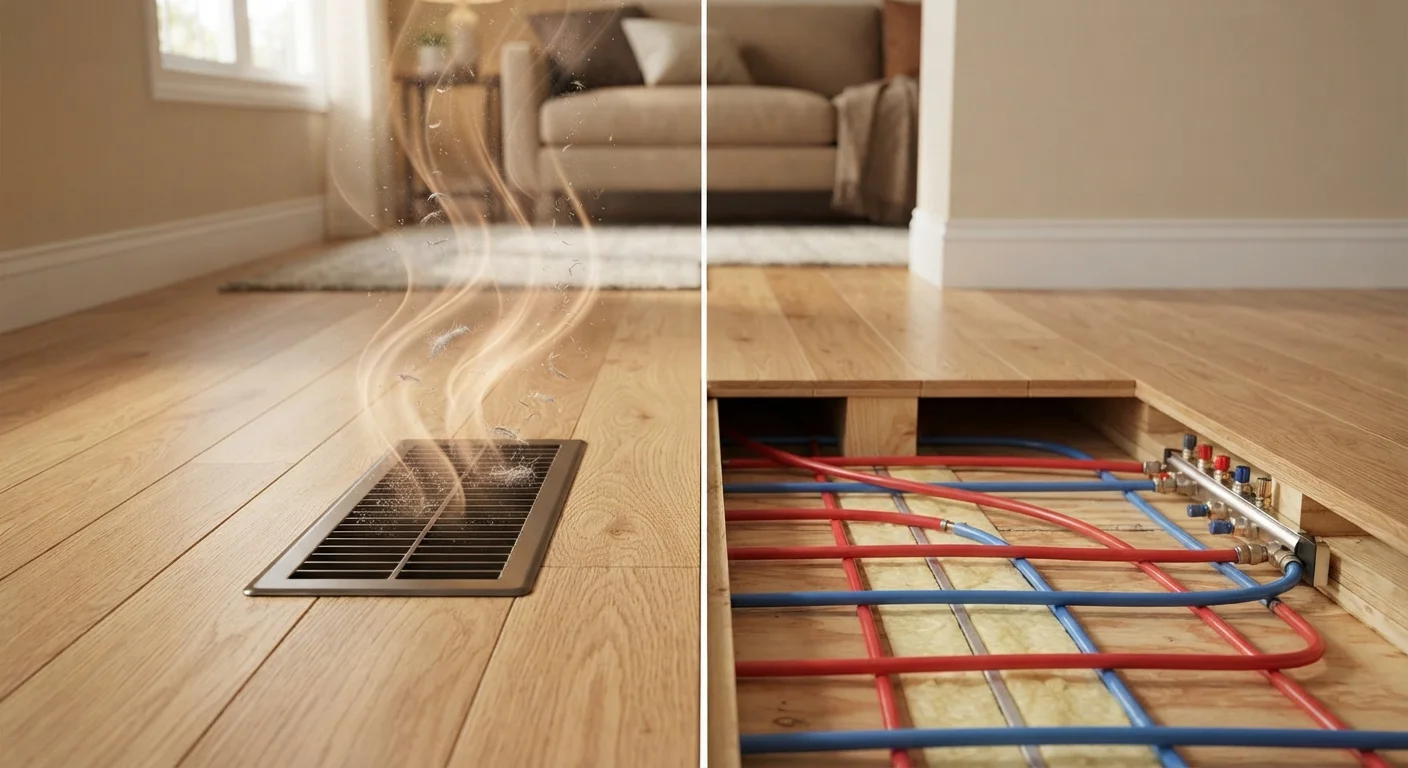
Photo credit: QuickInsights.net
In this article
Forced air and radiant heating systems age and fail differently. Here's what each means for your maintenance routine and repair budget.
Key Takeaways
- Forced air systems require more frequent maintenance tasks, especially filter changes and duct inspections.
- Radiant heat systems have fewer moving parts, which generally means lower routine maintenance demands.
- Repairs to radiant systems - particularly hydronic leaks - can be more disruptive and costly when they do occur.
- Both systems benefit from annual professional inspections to catch problems before heating season.
- Your home's existing infrastructure heavily influences which system makes sense for renovation or replacement.
How Each System Works - and Why It Matters for Maintenance
Forced air heating uses a furnace to heat air and then distributes it throughout your home via a network of ducts and vents. A blower motor pushes that conditioned air to every room, and a return duct system pulls stale air back to be reheated. This constant movement of air through multiple mechanical components - the furnace, the blower, the filter housing, and the ductwork - creates several maintenance touch points.
Radiant heat works differently at a fundamental level. Instead of moving air, it warms surfaces directly. Hydronic radiant systems (the most common type) circulate heated water through tubing embedded beneath floors or inside walls. Electric radiant systems use resistive cables or mats. Because heat radiates outward from those surfaces, the system doesn't need a blower, ducts, or vents to function. Fewer moving parts generally translates to fewer routine tasks - but the ones that do arise can be harder to access.
Understanding these differences is the foundation of smart home upkeep. See how heating fits into your broader responsibilities in our comprehensive new homeowner maintenance guide.
| Criterion | Forced Air | Radiant Heat |
|---|---|---|
| Filter maintenance | Every 1-3 months | Not required |
| Duct/distribution upkeep | Periodic inspection and sealing | No ducts; minimal equivalent |
| Annual professional service | Furnace tune-up required | Boiler or water heater service |
| Repair accessibility | Components generally easy to access | In-floor components hard to reach |
| Technician availability | Widely available nationwide | More specialized; varies by region |
| Impact on indoor air quality | Circulates dust and allergens | No air circulation |
| Typical system lifespan | 15-25 years (furnace) | 20-35+ years (tubing) |
Forced Air: Your Ongoing Maintenance Checklist
Forced air systems ask more of you on a regular basis. The most important - and most commonly neglected - task is changing the air filter. Depending on your household (pets, dust levels, occupant sensitivities), filters typically need replacing every one to three months. A clogged filter restricts airflow, strains the blower motor, and reduces efficiency.
Ductwork is the other major maintenance consideration. Over time, ducts can accumulate dust, develop small leaks at seams and joints, or harbor mold if moisture infiltrates the system. Leaky ducts can reduce heating efficiency noticeably. Professional duct inspection and sealing is generally recommended every few years, or sooner if you notice uneven heating between rooms or visible gaps near vent connections.
Annual furnace tune-ups by a licensed HVAC technician are also standard practice. A technician will check the heat exchanger for cracks (a safety-critical inspection), test the ignition system, clean the burners, and verify that the blower is operating within spec. Incorporating these inspections into a seasonal routine - ideally before the first cold snap - keeps you ahead of failures. Our month-by-month home maintenance calendar can help you build this into a year-round habit.
15-20%
Energy lost through leaky ducts
The U.S. Department of Energy estimates that a typical home with forced air loses roughly 20-30% of conditioned air through duct leaks, though estimates vary by system condition.
1-3 months
Recommended forced air filter change interval
Most HVAC manufacturers and industry guidance recommend replacing standard 1-inch filters every one to three months depending on household conditions.
35+ years
Potential lifespan of hydronic radiant tubing
Well-installed cross-linked polyethylene (PEX) tubing used in hydronic radiant systems is rated for several decades under normal operating conditions.
Radiant Heat: Fewer Tasks, but Higher Stakes When Problems Arise
Day-to-day, radiant systems are remarkably low-maintenance. Hydronic systems do require periodic attention to the boiler or water heater that feeds them - including annual professional servicing, checking system pressure, and bleeding air from the lines. But there are no filters to swap, no duct joints to seal, and no blowers to wear out.
The challenge with radiant systems is that problems, when they occur, can be significantly more invasive to fix. A leak in hydronic tubing embedded in a concrete slab, for example, may require breaking into the floor to locate and repair it. Electric systems can develop faults in the heating cables that are similarly difficult to isolate. This is why proper installation quality and regular boiler maintenance matter so much - prevention is far less disruptive than repair.
Radiant systems also interact closely with your home's insulation. Without adequate thermal resistance beneath the tubing, heat escapes downward rather than radiating into living spaces. This is a good reason to pair your heating decisions with an assessment of your home's envelope - our article on attic insulation and ventilation covers how building envelope choices affect comfort and efficiency.
Repair Costs and Long-Term Budget Considerations
Forced air systems benefit from a large, competitive service network. Most HVAC technicians are trained on gas and electric furnaces, parts are widely available, and even significant repairs - like a blower motor or heat exchanger replacement - can often be completed in a single service visit. The trade-off is that there are more components that can fail: motors, belts (in older systems), igniters, pressure switches, and control boards.
Radiant systems have longer average component lifespans - hydronic tubing in a well-installed slab system can last several decades - but specialized repairs require technicians familiar with radiant-specific equipment. In some regions, finding qualified radiant repair professionals takes more effort. Electric radiant systems, while simpler, can be expensive to operate continuously in colder climates due to electricity costs.
Both system types benefit from the philosophy of addressing small issues before they compound. If you're considering energy-related upgrades alongside your heating choices, our guide to energy efficiency upgrades outlines how insulation, windows, and mechanical systems work together.
This article is for general informational purposes only. Heating system selection, installation, and repair should be evaluated by a licensed HVAC professional familiar with your home's specific conditions, local building codes, and applicable permit requirements.

Author
Home & Garden Editorial Team
Home & Garden Editorial Team is the collective byline for our editorial team and contributor network. Articles published under this byline or an editorial pen name are researched, written, and reviewed according to our editorial standards for clarity, consistency, and independence before publication.
View all articles →