
Home Workouts vs. Gym Training: Weighing the Real Trade-Offs
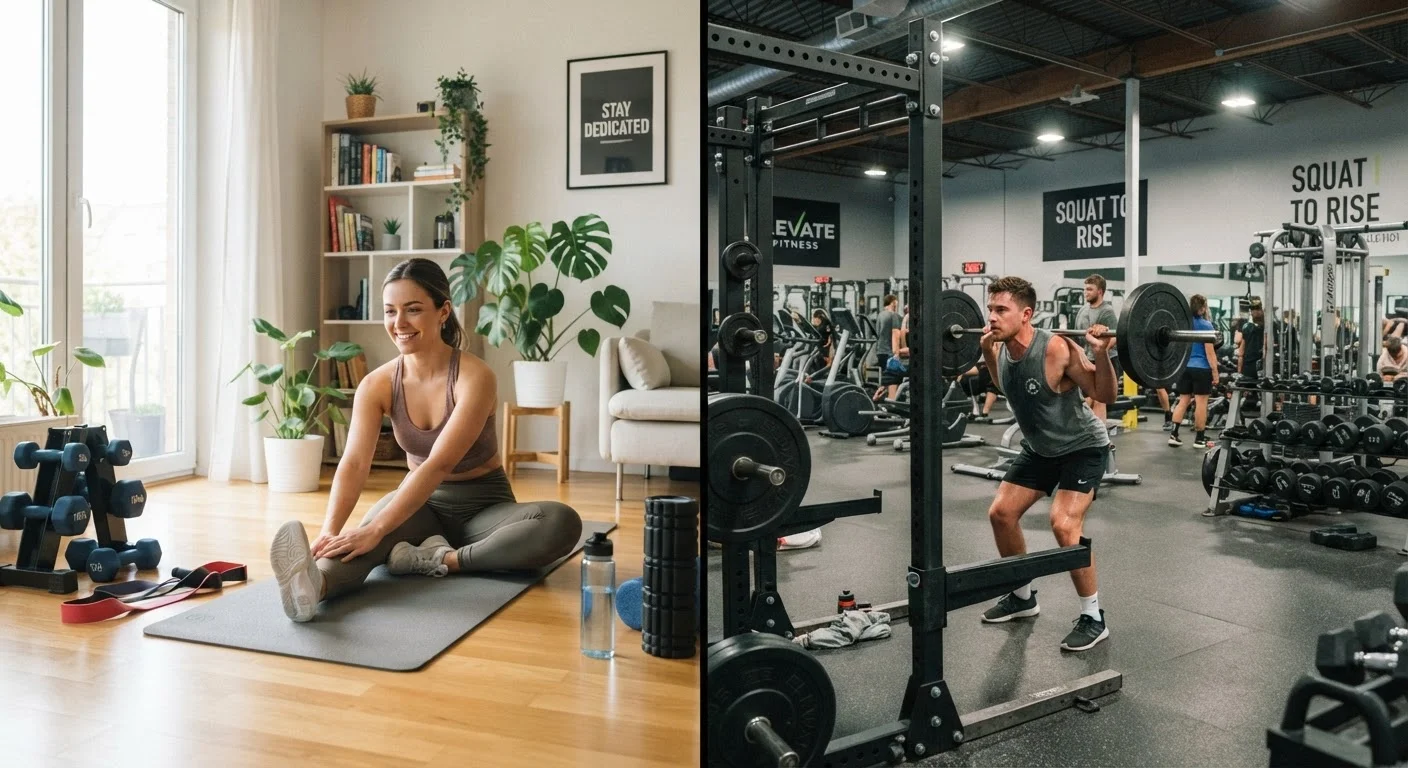
Photo credit: QuickInsights.net
In this article
Cost, consistency, equipment, and motivation—an honest comparison of exercising at home versus going to a gym to help you decide what fits your life.
Key Takeaways
- Home workouts eliminate commute time and gym fees, making consistency easier for busy schedules.
- Gyms provide access to specialized equipment and professional guidance that most home setups cannot replicate.
- Motivation and accountability patterns differ significantly between the two environments.
- Neither option is universally superior - the best choice is the one you'll actually stick with.
- A hybrid approach combining both settings works well for many people.
No commute - train on your own schedule
Eliminating travel time removes one of the most cited barriers to exercise. A 30-minute session can happen between meetings, early in the morning, or late at night without logistical planning.
Lower ongoing cost after initial setup
Once basic equipment is purchased, home workouts carry no recurring fees. Over a year or more, this can represent significant savings compared to a monthly gym membership.
Privacy reduces self-consciousness for beginners
Many beginners report feeling intimidated in gym environments. Exercising at home allows people to learn movements and build confidence without social pressure.
Flexible session length and structure
Home training adapts easily to a 20-minute window or a full hour without the overhead of travel or locker-room time, making it practical for genuinely busy adults.
Distractions and lack of dedicated space
Home environments compete with screens, household chores, and family demands. Without a defined, dedicated workout area, maintaining focus can be genuinely difficult.
Equipment ceiling limits advanced training
Progressive overload - a core principle of strength development - eventually requires heavier or more varied resistance than most home setups provide without substantial investment.
Motivation without external accountability is harder to sustain
Without a scheduled class, a training partner, or a coach watching, it's easier to cut sessions short or skip them entirely, particularly during low-energy periods.
No access to professional guidance on-site
Form errors and inefficient programming are harder to catch at home. Poor technique, left uncorrected, can increase injury risk over time - especially with loaded movements.
The Real Question Isn't Which Is Better - It's Which Fits Your Life
Fitness advice often frames the home-vs.-gym debate as a competition with a clear winner. In reality, both environments can produce meaningful health improvements - the research on exercise consistently shows that the most effective workout is the one performed regularly. What differs between settings is the context that makes regular exercise more or less likely for a given person.
Before weighing specific trade-offs, it helps to acknowledge a few common misconceptions. You don't need heavy equipment to build strength, and a gym membership doesn't automatically translate into fitness progress. See our breakdown of fitness myths that hold beginners back for more on separating fact from assumption.
Advantages and Disadvantages of Home Workouts
Exercising at home removes several barriers that cause people to skip sessions - there's no commute, no waiting for equipment, and no membership fee. Bodyweight exercises, resistance bands, and a single set of adjustable dumbbells can support a solid foundation in both strength and cardio for most beginners.
No commute - train on your own schedule
Eliminating travel time removes one of the most cited barriers to exercise. A 30-minute session can happen between meetings, early in the morning, or late at night without logistical planning.
Lower ongoing cost after initial setup
Once basic equipment is purchased, home workouts carry no recurring fees. Over a year or more, this can represent significant savings compared to a monthly gym membership.
Privacy reduces self-consciousness for beginners
Many beginners report feeling intimidated in gym environments. Exercising at home allows people to learn movements and build confidence without social pressure.
Flexible session length and structure
Home training adapts easily to a 20-minute window or a full hour without the overhead of travel or locker-room time, making it practical for genuinely busy adults.
The downsides are real, however. Distractions at home - family members, household tasks, screens - compete for attention in ways a dedicated gym space does not. Equipment limitations become significant if your goals include heavier strength training or sport-specific conditioning. And without external accountability, motivation can erode quietly over time. Understanding how to build consistency that doesn't depend on motivation becomes especially important for home trainers.
Distractions and lack of dedicated space
Home environments compete with screens, household chores, and family demands. Without a defined, dedicated workout area, maintaining focus can be genuinely difficult.
Equipment ceiling limits advanced training
Progressive overload - a core principle of strength development - eventually requires heavier or more varied resistance than most home setups provide without substantial investment.
Motivation without external accountability is harder to sustain
Without a scheduled class, a training partner, or a coach watching, it's easier to cut sessions short or skip them entirely, particularly during low-energy periods.
No access to professional guidance on-site
Form errors and inefficient programming are harder to catch at home. Poor technique, left uncorrected, can increase injury risk over time - especially with loaded movements.
What the Gym Offers That Home Can't Easily Replicate
A commercial gym's primary advantage is equipment depth. Barbells, cable machines, squat racks, rowing machines, and group fitness classes cover training modalities that a typical home setup cannot match without significant investment. For individuals pursuing specific goals - powerlifting, sports conditioning, supervised rehabilitation - a gym environment provides tools that matter.
~$600
Average annual U.S. gym membership cost
Industry estimates from fitness market analyses place the average American gym membership between $40-$60 per month, totaling roughly $480-$720 annually before initiation fees.
67%
Gym members who rarely use their membership
Multiple fitness industry surveys have estimated that a significant majority of gym members - often cited around two-thirds - attend infrequently relative to their intentions, highlighting that access alone doesn't drive consistency.
The social dimension also plays a documented role. Exercising alongside others, whether in a class or simply sharing a space, tends to increase perceived effort and enjoyment for many people. Access to certified personal trainers - even for occasional consultations - can meaningfully reduce the risk of poor form and wasted effort. For a deeper look at how different training types affect the body, see our guide on cardio vs. strength training.
When to Consider Professional Guidance
Whether you train at home or at a gym, working with a certified personal trainer - even for a few sessions - can be especially valuable when you're just starting out, returning after injury, or plateauing despite consistent effort. A qualified professional can assess your movement patterns, suggest programming adjustments, and help you train more safely. This is general guidance; consult a healthcare provider if you have any medical conditions that may affect exercise.
Cost, Commitment, and the Hybrid Middle Ground
Cost comparisons depend heavily on local gym prices and what home equipment you'd realistically purchase. A basic gym membership in the U.S. typically runs between $20 and $60 per month, while a modest home setup - mat, bands, a set of dumbbells - might cost $150-$300 as a one-time investment. Premium gym memberships or boutique fitness studios can run considerably higher.
Many people find that a hybrid approach removes the either/or pressure entirely: bodyweight and resistance-band sessions at home on weekday mornings, with gym visits for heavier lifting or classes on weekends. This model leverages the convenience of home training while preserving access to equipment and community. Whatever structure you choose, listen to recovery signals alongside training ones - knowing when rest is the most productive choice applies regardless of where you train.
This article is for general informational and educational purposes only and is not a substitute for professional medical or fitness advice. Consult a qualified healthcare provider or certified fitness professional before beginning any new exercise program, especially if you have an existing health condition.

Author
Health & Wellness Editorial Team
Health & Wellness Editorial Team is the collective byline for our editorial team and contributor network. Articles published under this byline or an editorial pen name are researched, written, and reviewed according to our editorial standards for clarity, consistency, and independence before publication.
View all articles →